Gear pick
Best Fertilizer for Succulents: 4 Liquid or Pellet Picks by NPK
Quick answer
The best fertilizer for succulents is a weak one used lightly while the plant is growing: a liquid plant food with small NPK numbers such as 1-1-2 or 0.5-1-1, or a few coated slow-release pellets on the soil. My first pick is Dr. Earth Succulence 1-1-2 in the pump bottle. For a shelf of indoor pots I’d take Miracle-Gro’s cactus and succulent pump. A big collection is easier to cover with Espoma Cactus! concentrate, and outdoor pots you want to feed once and forget suit Osmocote Plus pellets.
I sort fertilizer by type, not by brand, because I ran a tray of succulents on three kinds of fertilizer against plain water. Below are the four plant foods, then what that tray showed me, how to read the NPK numbers, when and how much to feed, and the label claims I’d ignore.
Best succulent fertilizers to buy: liquid concentrate, pump bottle or slow-release pellets
As an Amazon Associate I earn from qualifying purchases.
Only one of the Amazon links below opens a product page: the Espoma one, which is the listing Espoma’s own site links to. The other three open an Amazon search for the product’s name, not a product page I’ve checked. Match the name, the size and the NPK numbers on the listing against this page before you order.
Succulent fertilizer comes in three forms. A concentrate gets measured into a watering can, a pump bottle goes straight onto the soil, and coated pellets sit on the surface and release for months. The form decides how easy it is to overdo, so that’s how I group them.
How much any of them matters depends on what’s in the pot. An all-grit mix holds almost no nutrients, while a peat-based bag often has plant food mixed in already. I sort those bags in my guide to the best soil for succulents.
| Plant food | Form | NPK on the product page | How the label says to use it | Who it suits |
|---|---|---|---|---|
| Dr. Earth Succulence Cactus & Succulent Plant Food | Liquid, pump bottle | 1-1-2 | Two pumps on the soil, water within 24 hours | Most growers with a handful of pots |
| Miracle-Gro Indoor Plant Food for Cactus & Succulent | Liquid, pump bottle | 0.5-1-1 | 2 pumps for small pots, 4 for large | Indoor pots and first-time feeders |
| Espoma Organic Cactus! | Liquid concentrate | Not given on the product page | 1/2 cap (2 tsp.) per quart of water | Big collections watered by can |
| Osmocote Smart-Release Plant Food Plus Outdoor & Indoor | Coated pellets | 15-9-12 | Scatter once; feeds up to 6 months | Outdoor pots you rarely fuss over |
Pump-bottle liquid succulent food: Dr. Earth Succulence and Miracle-Gro
Dr. Earth Succulence Cactus & Succulent Plant Food is the one I’d buy first (search Amazon for Dr. Earth Succulence; that opens search results, not a product page I’ve checked). Its label reads 1-1-2: 1% nitrogen, 1% phosphate and 2% potash, with a little calcium, sulfur and magnesium listed after them. It’s an organic liquid, and Dr. Earth says it makes it by upcycling food-grade waste.
Dr. Earth’s directions are short. Apply two pumps directly to the soil, water within 24 hours, and the bottle says that feeds the plant for two weeks. I like it for a windowsill or a small balcony group, because there’s nothing to measure and the numbers are low.
Its drawback is the bottle range. Only the 8 oz and 16 oz sizes come with a pump. Dr. Earth sells the 24 oz and 32 oz bottles as concentrate, so check the size before you order. Pumping pot by pot also gets slow once you have dozens of them.
Miracle-Gro Succulent Plant Food is the gentlest of the four by its numbers: 0.5-1-1 in an 8 fl. oz. pump bottle (search Amazon for Miracle-Gro Succulent Plant Food; search results again, not a checked product page). Miracle-Gro labels it for all indoor container-grown cactus and succulent plants, and names aloe vera, jade plants and echeveria among them.
The directions scale with the pot. Small pots get 2 pumps and large pots, over 6 inches (15 cm) across, get 4, then you water as usual. You can also add 8 pumps to 1 quart (about 1 liter) of water and water with that.
Two things to know before buying it. Check how many bottles a listing holds, because a multi-pack is a lot of plant food for a few pots. And Miracle-Gro recommends feeding every two weeks all year long, which is more often than I’d feed a succulent that has stopped growing for the season.
Liquid concentrate for a watering can: Espoma Organic Cactus!
Espoma Organic Cactus! is the pick for a large collection. Espoma says one 8 oz bottle makes up to 24 quarts (about 23 liters), mixed at 1/2 cap, or 2 teaspoons, per quart of water. You shake the bottle, mix, drench the soil thoroughly, and repeat every 2 to 4 weeks.
Espoma describes it as a blend of natural proteins with kelp extracts, humic acids and its own set of beneficial microbes. It’s the only one of the four that’s diluted before every use, so you can mix it weaker than the label when you want to.
That freedom is also the drawback, because every feed means a cap, a can and some arithmetic. Espoma’s product page doesn’t print the NPK numbers either, so you have to read them off the bottle itself.
Slow-release pellets for outdoor pots: Osmocote Plus
Osmocote Smart-Release Plant Food Plus Outdoor & Indoor is the one-and-done choice (search Amazon for Osmocote Plus Outdoor & Indoor; search results, not a checked product page). Its label reads 15-9-12, fortified with 11 essential nutrients, and one application feeds for up to 6 full months. Osmocote says you can apply it to potted plants indoors or outdoors, and backs it with a no-burn pledge when used as directed.
I’d keep it for outdoor pots in bright light. It isn’t made for succulents the way the three liquids are, and 15-9-12 puts nitrogen first. Follow the amount on the bag and stay at the low end of it for succulents.
The other drawback is that you can’t take it back. A liquid feed is over at the next watering, but pellets keep releasing for months, even when the plant has stopped growing.
What I saw when I fed succulents three kinds of fertilizer and plain water
My own evidence here is about fertilizer types, not these four brands. I set twelve small succulents in tin pots on one tray and split them into four groups of three: hydroponic fertilizer, houseplant fertilizer, succulent fertilizer and plain water.
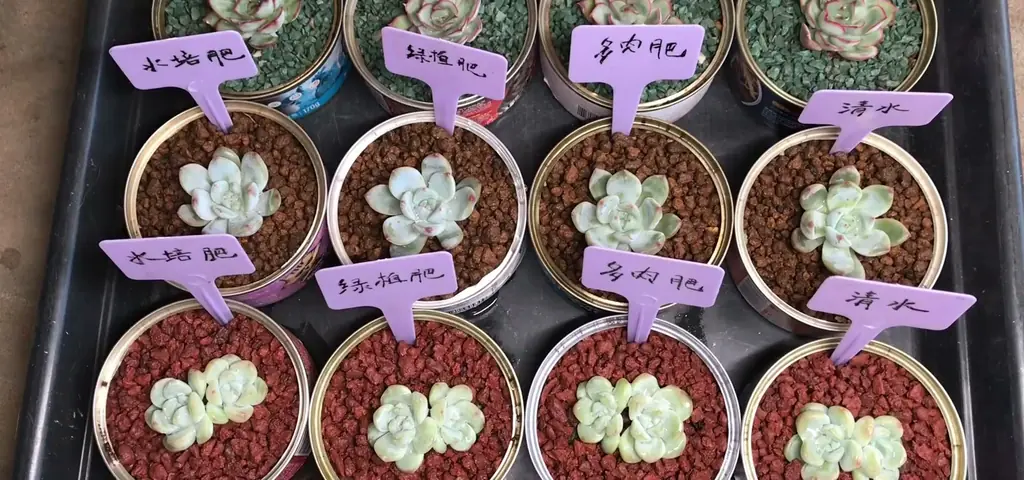
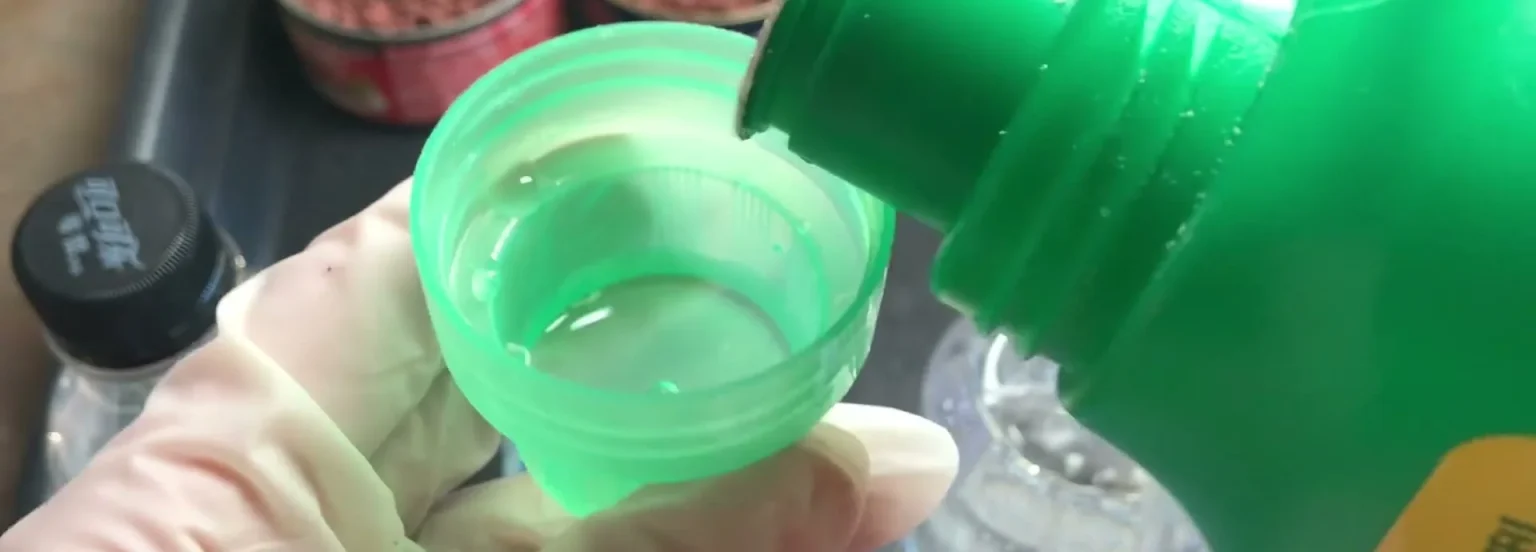
I mixed each one weak. My liquid’s label called for 7 to 9 drops per 17 fl oz (500 ml) of water. I put 3 drops in my 10 fl oz (300 ml) bottle, a little under that rate. The water-soluble granules went in at 1 part to 600 parts water.
Where I’ve fed and held back side by side, the change is the same every time. The fed plant gets much bigger, and it also gets looser. In the pair below, the right pot was fed and the left pot only got water.
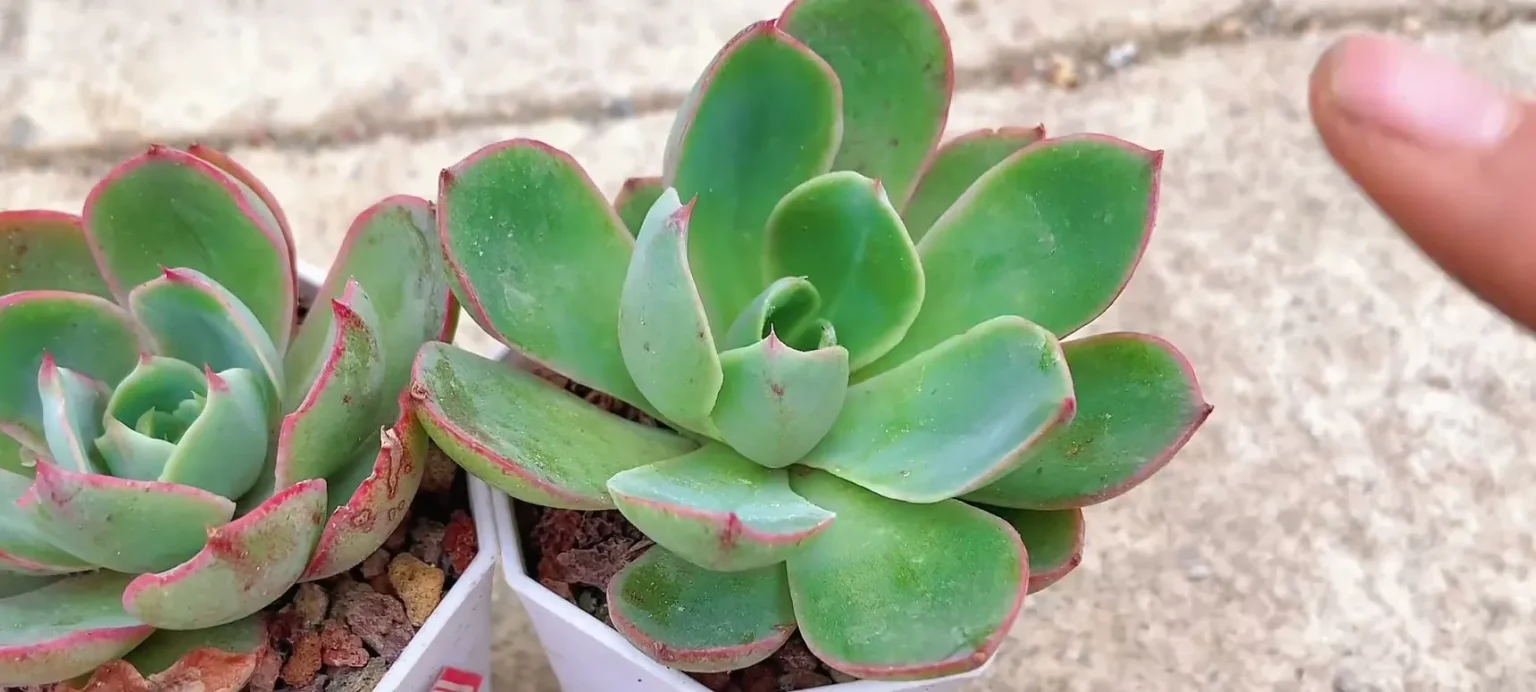
For that pair I dissolved one small scoop of fertilizer in about 1 quart (1 liter) of water. The size jumped. The tight rosette shape didn’t survive it, though, and I see the same trade in red varieties.
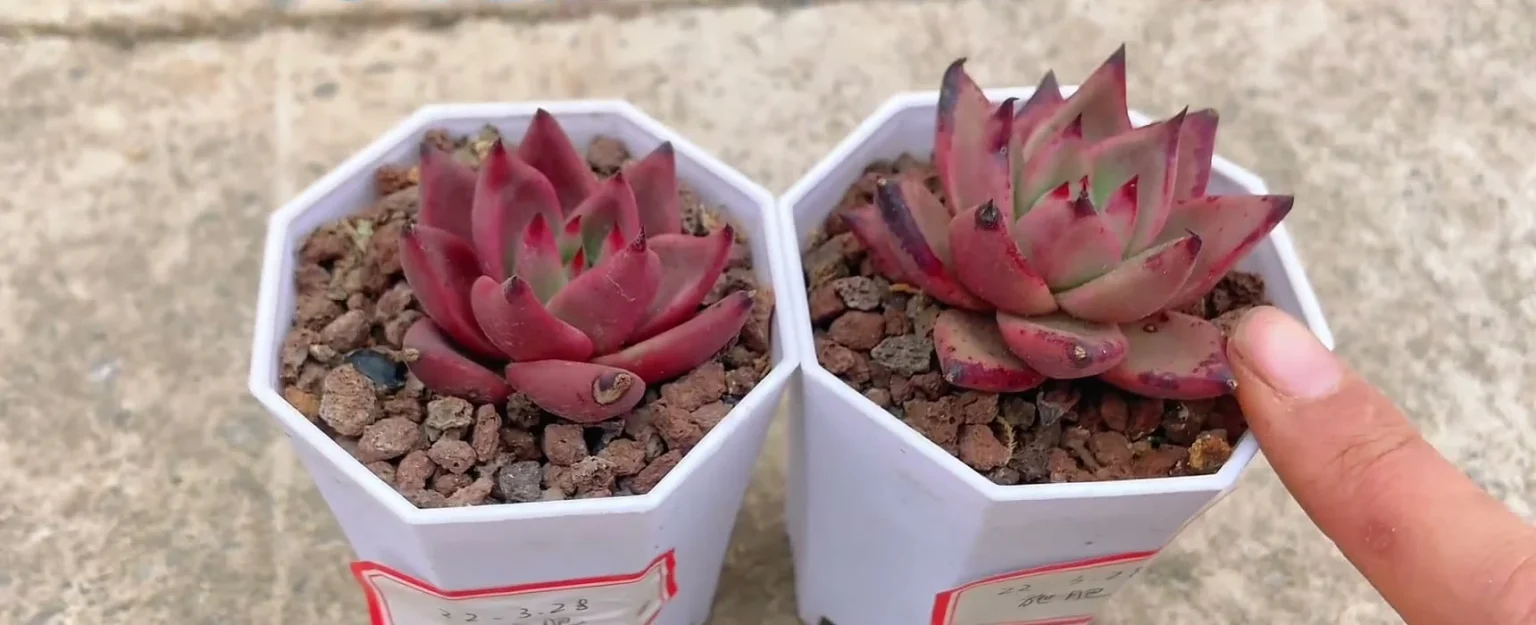
So fertilizer works on succulents, and that’s exactly why I pick weak ones. Feeding buys you size. It costs you the short, fat leaves and the compact shape most people grow these plants for.
How to choose succulent fertilizer: NPK numbers, form, timing and dose
How to read the NPK numbers on succulent fertilizer
The three numbers on a label are the percentages of nitrogen, phosphate and potash, in that order. Dr. Earth’s 1-1-2 means 1% nitrogen, 1% phosphate and 2% potash.
Read two things from them. The size of the numbers tells you how concentrated the product is. 0.5-1-1 and 1-1-2 are weak enough to pump onto soil undiluted, while a 15-9-12 pellet has to be coated so it releases slowly.
Then look at which number leads. Nitrogen drives leafy growth, and the stretched plants in my photos are what a lot of growth looks like on a succulent. I favor labels where nitrogen isn’t the biggest number, as on both pump bottles here.
Liquid concentrate, pump bottle or slow-release pellets
Choose the form by how many pots you have and how closely you watch them.
A pump bottle suits a few pots. The dose is counted in pumps, so it’s hard to get badly wrong. A concentrate suits a big collection, since one small bottle covers many watering cans, and you control the strength.
Pellets suit outdoor pots and large cacti you don’t want to mix feed for. The coated pellets I use on my rooftop release over roughly four months. A small pot needs only a few of them, scattered on the surface.
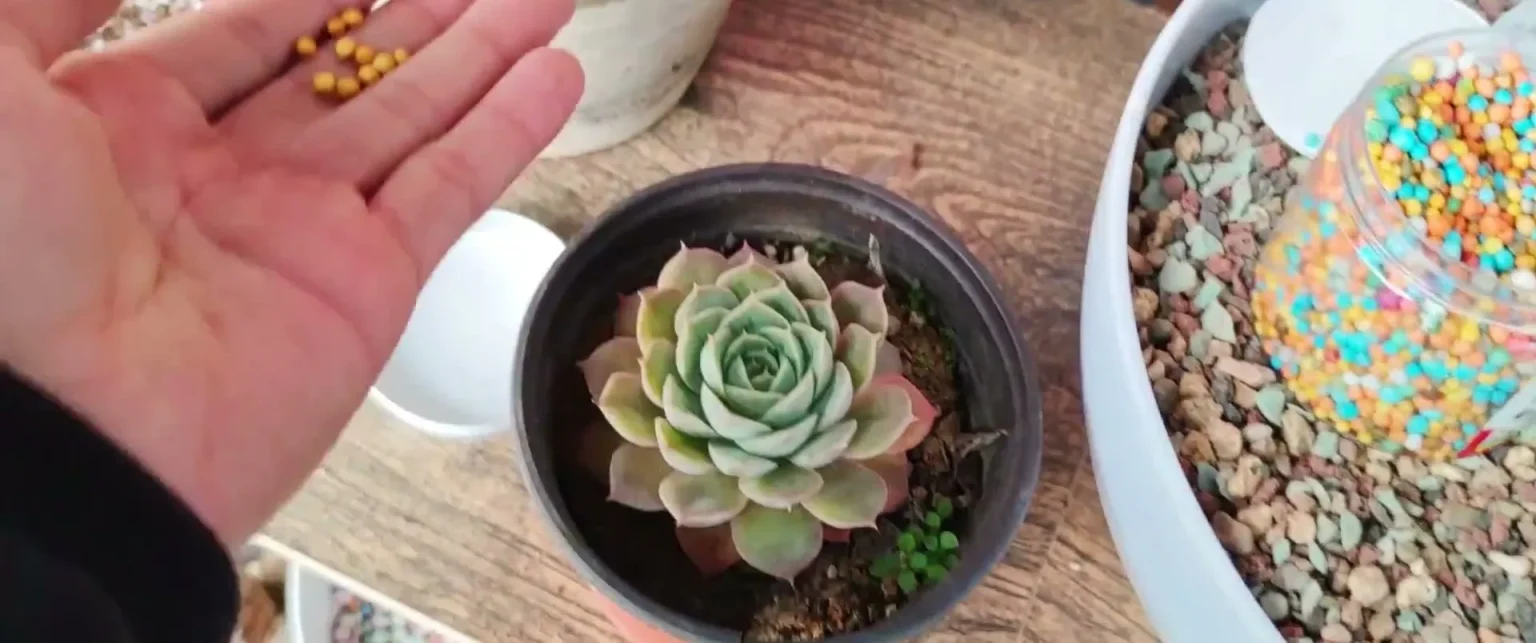
Old pellets tell you when they’re finished. Pinch one on the soil surface, and a spent pellet crumbles between your fingers.
When to feed succulents and how much to give
Feed only while the plant is putting on new growth. On my roof most succulents rest through the summer heat and the winter cold, so I feed in spring and autumn and stop in between. My succulent care guide covers how to tell which season a plant is in.
Soil changes the timing too. Plants in an all-grit mix depend on what you add, and my well-draining cactus mix is at that lean end. A peat-based bag with plant food already mixed in needs nothing for a while.
Skip fertilizer right after repotting succulents. I wait until the plant is clearly growing again before the first feed.
On dose, start at or under the label rate and never above it. I treat a feed as one of my normal waterings, on the same schedule I describe in how I water a succulent, not as an extra one. Potted cacti get the same light hand, as I explain in my cactus care guide.
Succulent fertilizer label claims that can mislead you
“Cactus & succulent” on the front. The words tell you who the product is marketed to. The NPK numbers and the directions tell you what it does. Compare those across bottles before the name.
A renamed bottle. Miracle-Gro Succulent Plant Food now carries the name Indoor Plant Food for Cactus & Succulent. Miracle-Gro says the name changed and the contents didn’t, so you may see either name on the same product.
Same brand, different bottle. Dr. Earth Succulence in 8 oz and 16 oz is a pump you apply straight to soil. In 24 oz and 32 oz it’s a concentrate. Using one the way the other is labeled gives a very different dose.
“Feeds up to 6 months.” That’s an upper limit, not a promise. My own pellets are done in about four months, so I check them by pinching and don’t count on the calendar.
Mixing a big batch to save time. Miracle-Gro recommends against storing pre-mixed or diluted plant food. I mix only what I’ll pour that day.
Bigger plants as proof. A before-and-after photo of a much larger succulent shows the fertilizer works. It doesn’t show whether the plant kept its shape, and in my pots it didn’t.
Succulent fertilizer questions: Miracle-Gro, how often, coffee grounds
Is Miracle-Gro OK for succulents? Yes, if it’s the one made for them. Miracle-Gro’s cactus and succulent pump food is 0.5-1-1 and labeled for indoor container-grown cactus and succulent plants. I’d use the 2-pump dose for small pots and feed only during growth.
How often should succulents be fertilized? The liquid labels here say every two weeks, or every 2 to 4 weeks for Espoma. I feed less often than that, only in spring and autumn, because every feed loosens the plant a little.
Do succulents need fertilizer at all? Not to stay alive in a mix with some peat or compost in it. In an all-grit mix they have almost nothing to draw on, so a light feed during growth keeps them from stalling.
What helps succulents grow faster? Fertilizer does, and my fed pots prove it. More light, a slightly bigger pot and regular water in the growing season help too. Expect a faster plant to be a looser one.
Will coffee grounds help succulents? I don’t use them. Grounds are fine organic matter that holds water against the roots, the opposite of what a gritty succulent mix is for. A measured liquid feed is easier to control.
What’s the best fertilizer for succulents indoors? A pump-bottle liquid with small numbers. Indoor plants get less light, so they stretch more easily when overfed, and I’d rather underfeed them.