Succulent Cuttings: How to Grow Succulents From Cuttings
Quick answer
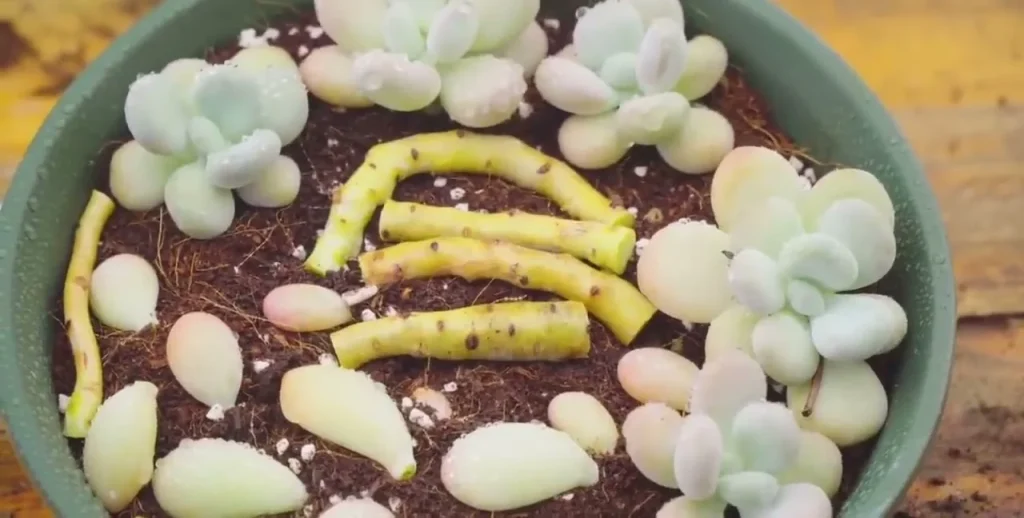
Succulent cuttings are pieces you cut from a plant so each one can root and grow on its own, and one long-stemmed plant usually gives you three kinds: the tight rosette at the tip, sections of the bare stem below it, and any widely spaced leaves. Cut close under the rosette with clean pruners, then dry every cut in bright shade until it seals, which takes two days to a week or more depending on stem thickness. A cut that’s still wet shouldn’t be buried.
My roof in Huizhou, in southern China, holds a lot of succulents, and every spring a few stretched plants get taken apart this way. Below I go through which parts to keep, where to cut, how to handle a stem that’s rotting, how the pieces dry, why my powders stay on the shelf, and what a batch looks like two months on.
What you need to take succulent cuttings
Taking cuttings needs one clean tool and somewhere to put the pieces afterward.
- Sharp pruners or scissors, wiped with rubbing alcohol
- A small clean knife, only if you have to scoop rot out of a stem
- A shallow tray of succulent mix for the pieces to rest on, not in
- A spot with bright light, no harsh direct sun and moving air
How to take succulent cuttings from a long-stemmed plant
There are two reasons to cut a stem like this.
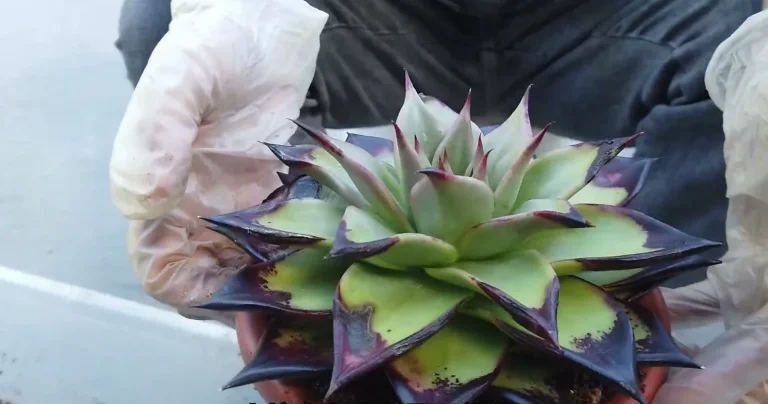
A truly leggy plant has big gaps between its leaves. Another plant can keep its leaves tight and still grow a long stem that flops over, like the one below. The cuts are identical for both.
If you’re still deciding between leaves, stems and offsets, the propagation guide has a table that sorts the options by plant shape.
Step 1: Read the plant from the top down. The compact part at each tip, where the leaves sit close together, becomes a rosette cutting. Any lower leaves with wide gaps between them come off for leaf propagation. The bare stem in the middle becomes sections.
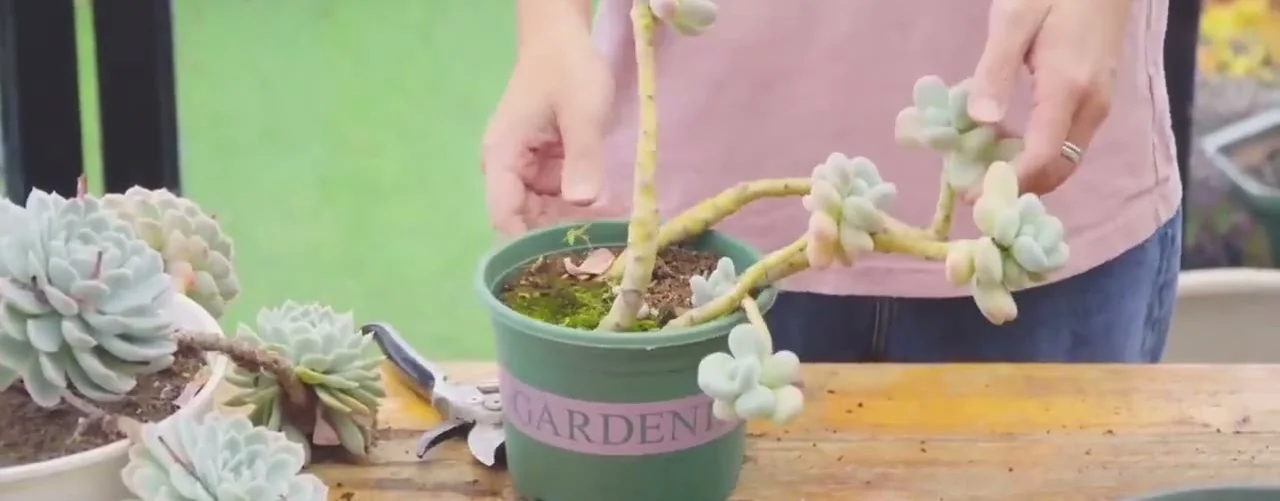
The rosette comes off first, while the stem is still in one piece and easy to hold.
Step 2: Hold the rosette and cut close under it. Steady the head with your free hand so it can’t drop, then set the blades on the stem just below it. Keep a short stem on the head, around 1 in (2.5 cm) if the leaves allow it, and close the blades in one motion. Side shoots take the same cut, so a sprawling clump with tight leaves can lose every side head this way.
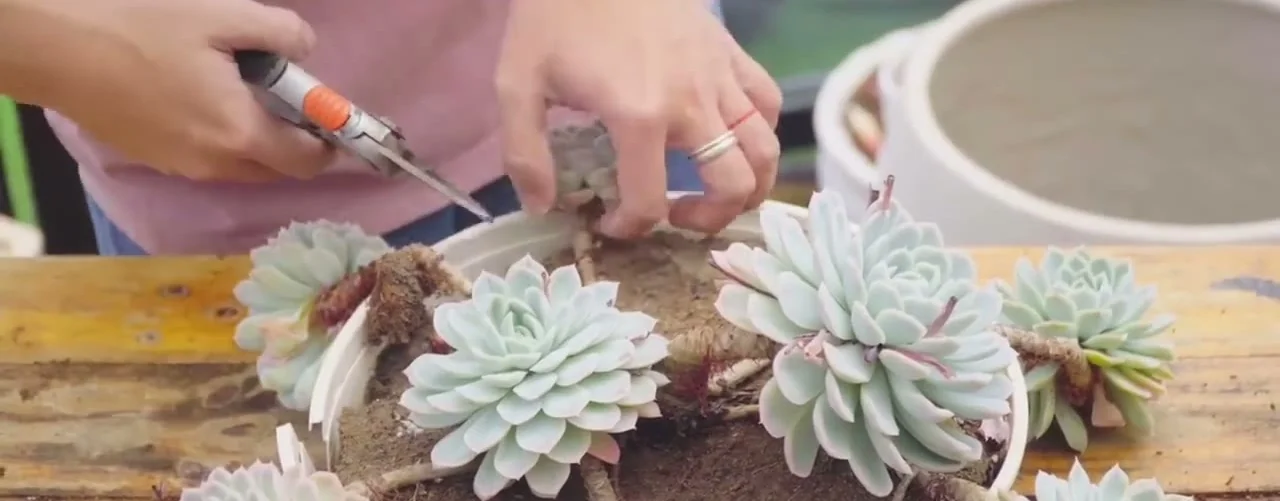
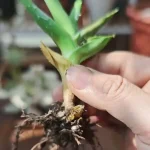
Step 3: Flip the rosette over and inspect the cut. You want a short stub under the rosette and a clean face that looks pale and wet. A discolored or soft patch on that face means the stem has a problem, and the rot section below covers what to do about it.
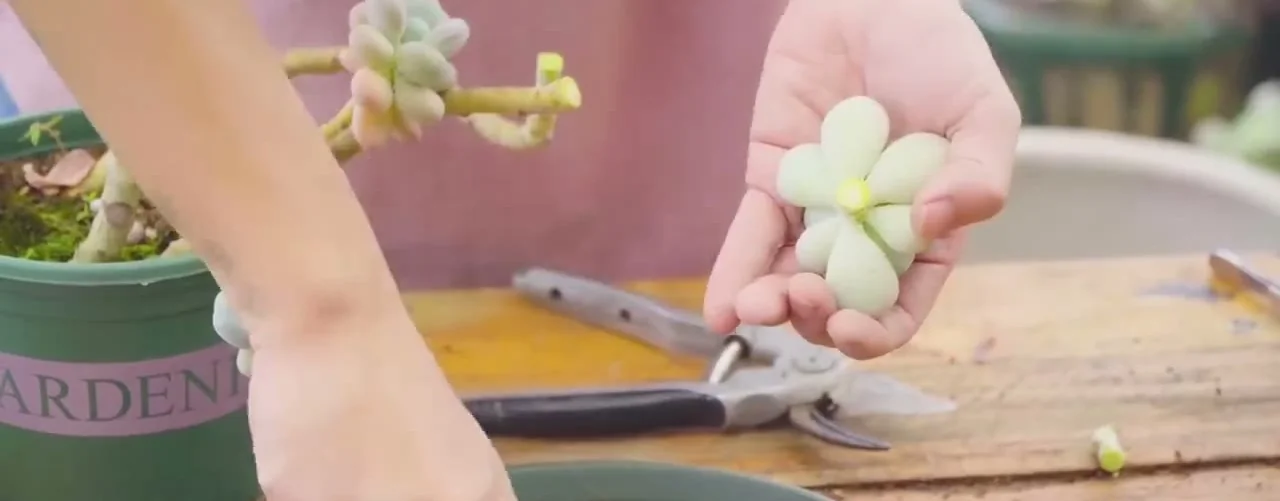
With the head off, what’s left on the stem is easier to sort.
Step 4: Pull off the widely spaced leaves. Strip them from the stem by hand so each one comes away whole. They go on the tray with everything else.
Step 5: Cut the bare stem into several sections. Pull the stem gently straight with one hand and snip it into short pieces with the other. I don’t measure, but mine come out around 2–3 in (5–8 cm) by eye. Leave a stub in the pot, because it still has its roots.
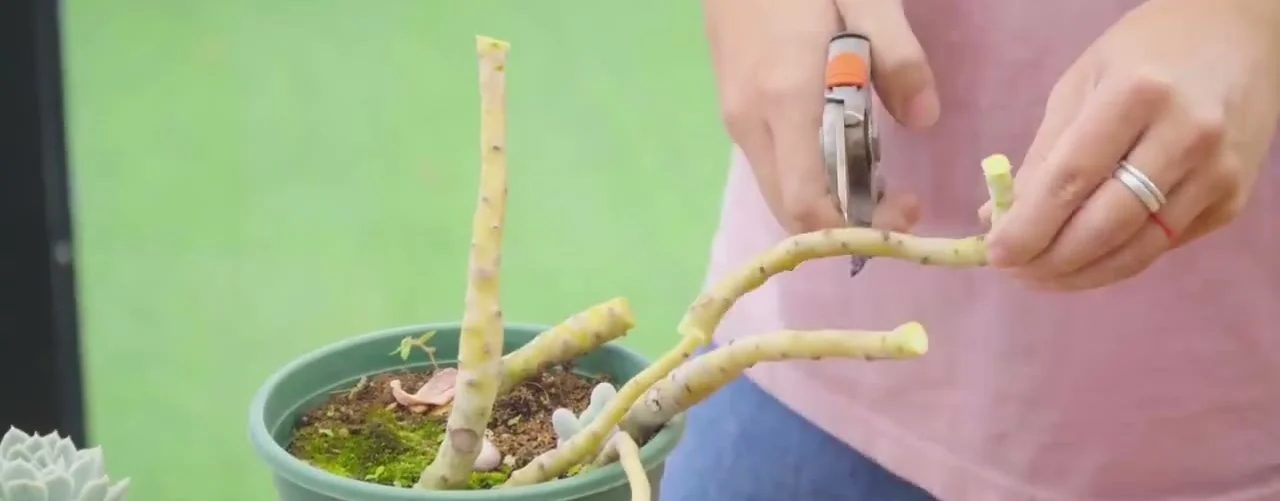
Step 6: Keep every section, even the curved ones. A stem with no leaves on it looks finished, but these pieces can sprout as well.
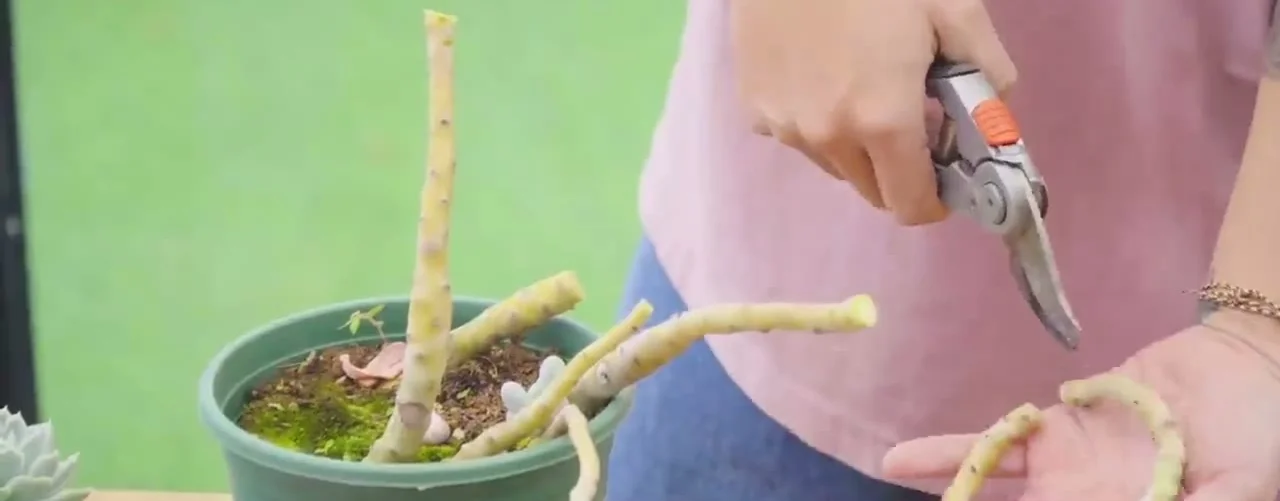
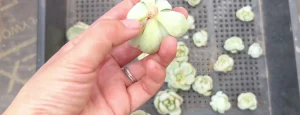
Step 7: Lay everything out in bright shade. Spread the tips, sections and leaves on the tray so nothing’s piled up, and leave them on the surface instead of burying them. Then move the tray somewhere bright that doesn’t get harsh direct sun.
The stump stays in its pot and carries on as a plant. Watering that stump and reading its new heads both have a place in my notes on beheading succulents, which also explain the thread method for flat rosettes that pruners can’t reach.
How to cut a succulent stem that’s rotting
A rotting stem changes where you cut, because you’re cutting back to healthy tissue instead of cutting for shape.
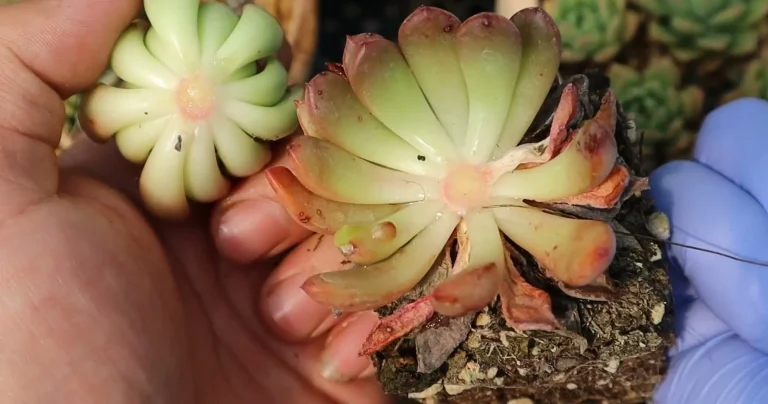
The warning sign is easy to miss. One of my two-headed plants sat in normal light, and however hard I held back water, its leaves kept spreading flat like a pancake. That pointed underneath the leaves, so I suspected the roots and took the stem off.
The stem used to be long. By the time I cut, the rot had climbed almost to the fork, and any later I’d have been left with two single heads.
Even that high up, the middle of my cut still showed some damage.
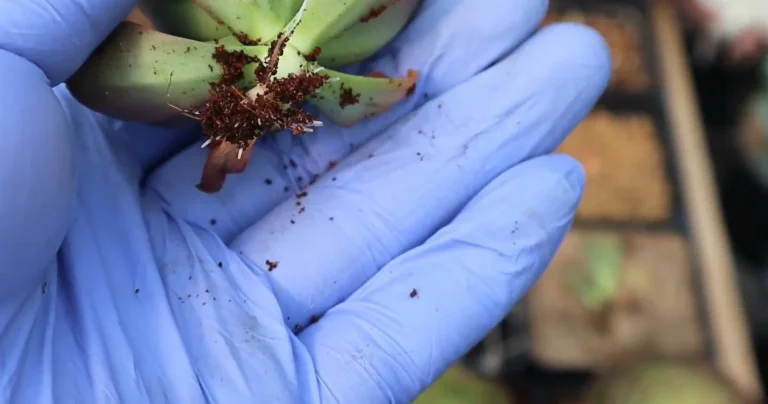
There was no stem left to give up, so the fix had to be small. Take a clean knife, scoop a little pit out of the center to lift the bad part away, and leave the outer ring of the stem alone.
Then the cut goes to dry like any other.
How to dry succulent cuttings until the cut seals
Every cut dries the same way, healthy or rescued: in open air with nothing on it.
Bright light without harsh sun is what you want, plus air that moves. In a rainy spell mine wait indoors with a window open. How long depends mostly on the stem:
- Thin stems: two to three days
- A typical rosette stem: four to five days
- Thick stems, or any stem in humid weather: a week or more
A cut is ready when it feels dry and firm, whether it ends up pale or brown. If it’s still tacky, give it another day.
That dry seal is called a callus, and the succulent glossary defines it alongside the other propagation terms.
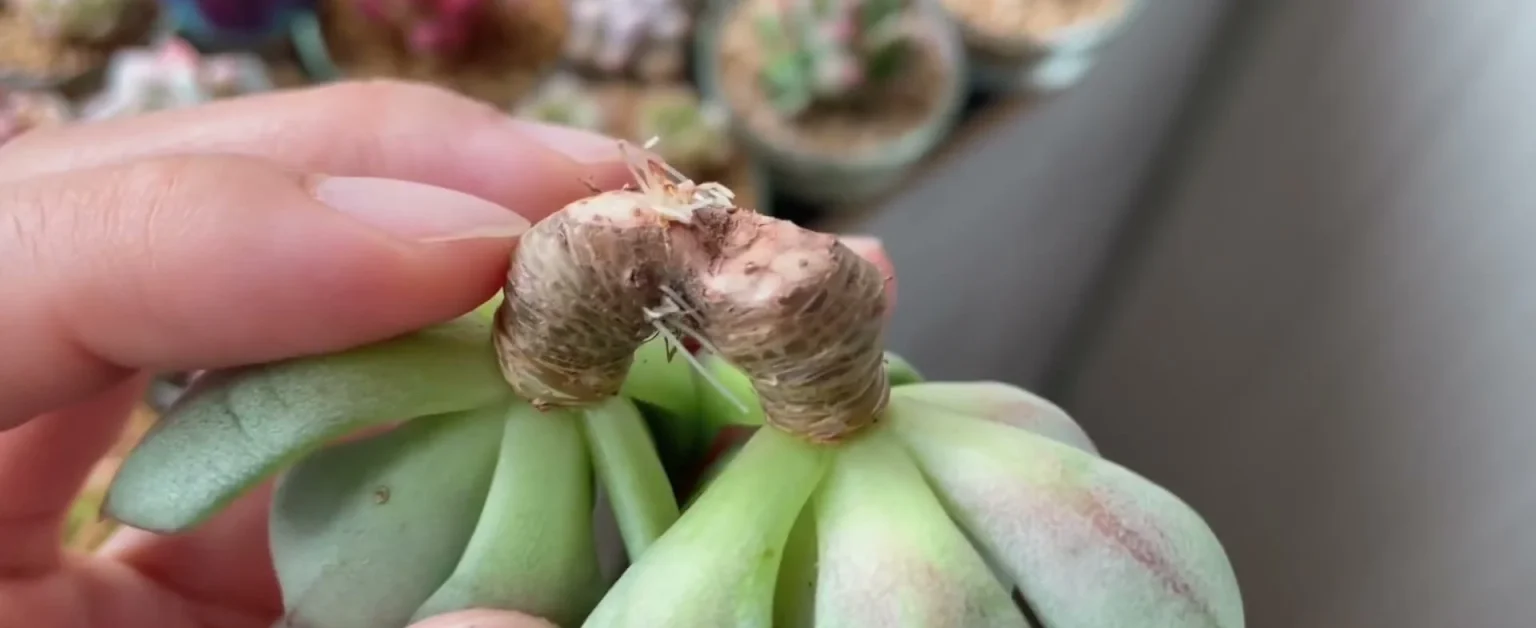
Those numbers are the minimum, and a cutting can sit out longer. I left the two-headed rescue for about two weeks, and the stub ends shrank into hard brown scabs.
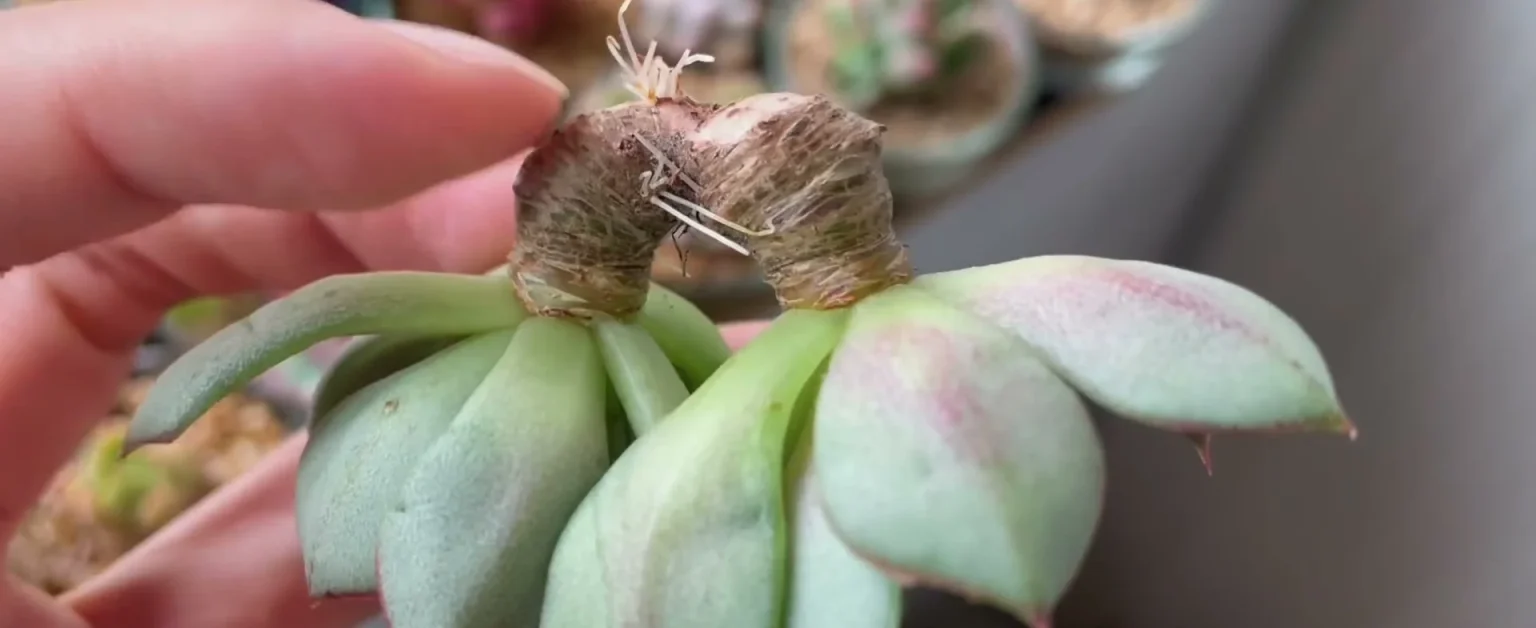
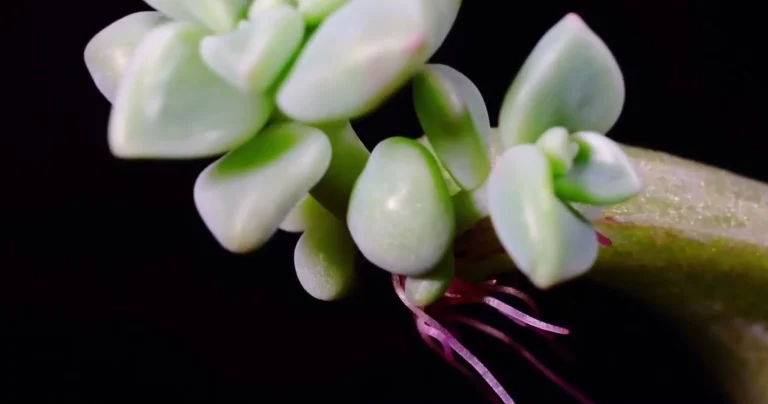
By then new callus had formed over the cuts, and thin roots had started without any soil at all. A cutting at that stage can go straight into a pot.
Why I don’t put fungicide or rooting powder on succulent cuttings
Leaving the cut alone is the whole treatment on my roof, so fungicide powder and rooting powder stay in the cupboard.
A fresh cut holds a lot of water, and a dry powder pulls that water out. The stem then shrivels back, and you lose a bit more of it than you had to.
If you already have these powders and want to use them, keep them off the cut. Mix them into the soil at potting time, then plant as usual.
Keep succulent cuttings away from heat while they dry
Heat does more damage to a cutting than a slow start does, and a grow light taught me that.
I’d rested a beheaded head on top of the lamp, then forgot to lift it off before the lamp came on that afternoon. The stem side got far too hot. Some leaves scorched, and others turned watery and translucent.
Whole plants melt the same way in summer. Leaves full of water can’t handle days of 95–104°F (35–40°C), and they collapse.
Holding back water doesn’t completely protect them either, since some varieties melt at those temperatures even when kept strictly dry. Shade is a must in that kind of heat, watered or not.
So when a hot spell’s on the way, I postpone the cutting if I can. Anything already cut stays in the shade.
What succulent cuttings look like two months later
Two months is when I judge a batch, as long as the tray has stayed in bright light without harsh sun. By that point, each part of the plant has done something different:
- The stump in the pot is packed with new buds.
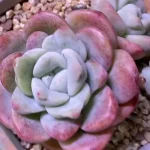
- The rosette tips have well-developed roots and read as normal plants again.
- The stem sections have sprouted, and their new plants are a good size.
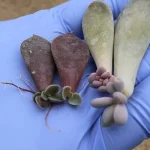
- The widely spaced leaves have turned into small leaf seedlings.
- Side heads cut from a clump have pots full of roots.
Keep all of them out of hard sun until roots form, then ease them into more light.
The wait for roots has its own page, how to root a succulent, including the reasons a cutting refuses to start. For depth in the pot, planting succulent cuttings gives the numbers for each kind.
Questions about taking succulent cuttings
When is the best time to take succulent cuttings?
Spring is my first choice, and early fall works too, in the weeks that stay between about 60°F and 80°F (15°C and 27°C). I avoid the peak of a hot, wet summer, because a fresh cut heals slowly then.
Can you grow succulents from cuttings without rooting powder?
Yes. A clean cut that dries in moving air will root on its own, and that’s how all of my succulents get started.
Why do some people put cinnamon on succulent cuttings?
Some people dust it on a fresh cut hoping to slow fungus. It’s a dry powder like any other, so I leave it off and let the air do the work.
Why is it illegal to propagate some succulents?
Some newer varieties are patented. In the United States, a plant patent lets the breeder stop others from reproducing that variety by cuttings, generally for 20 years from filing. Tags on these plants often show “PP” with a number, or “PPAF” while the patent is pending.
How long can succulent cuttings stay out of soil?
Weeks, if they’re in the shade and the leaves stay firm. My two-headed rescue spent about two weeks out of soil and rooted anyway.
Succulent Primer has more care guides for the plants these cuttings turn into.