Succulent Leaf Cuttings: How to Grow Them in Soil, Not Water
Quick answer
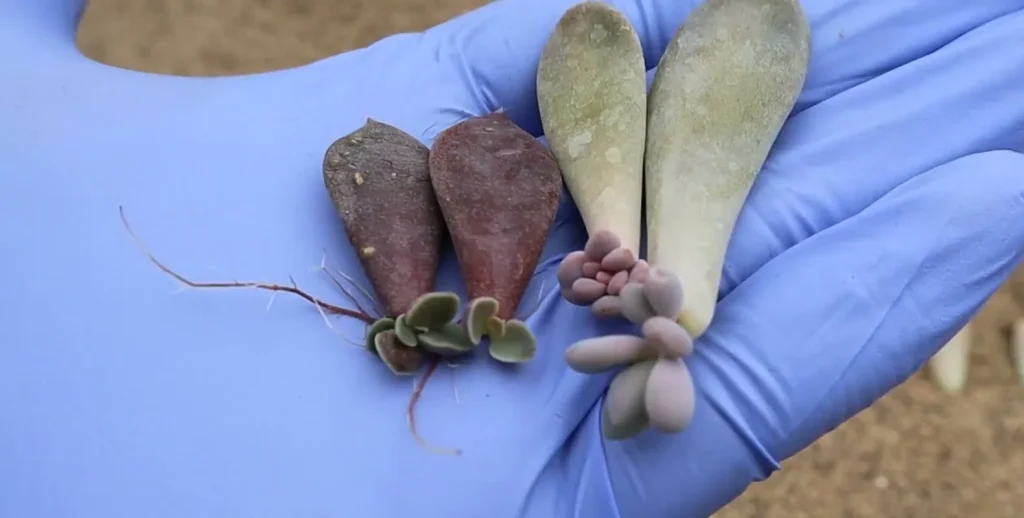
Succulent leaf cuttings are single leaves taken whole from a plant, and each one can grow roots and a new rosette of its own. To grow them, rock a leaf off sideways, check that its base is intact, lay it on a slight soil slope, and give it no water until roots appear. First roots or a tiny bud usually show in about 2 to 6 weeks. The one thing you can’t fix later is the growing point, the small scar at the base of the leaf, so a leaf that breaks there is usually finished before it starts.
Leaf propagation is the cheapest way I know to turn one plant into a whole tray of young ones. My own leaf cuttings go into a brick-edged bed of gritty soil, up on the roof of my house in Huizhou, southern China. A bed like that is really just a very large pot, so the same steps work in a shallow pot or tray. Below I go through picking, checking and laying the leaves, then the three things that throw people off: curled leaves, leaves with only roots, and leaves with only a sprout.
What you need for succulent leaf cuttings
Leaf cuttings take very little kit, and most of it is probably already on your bench.
- A plant that grows from leaves. Plump-leaved rosettes suit this well. The propagation methods sorted by plant type show which ones do better from stems or offsets.
- Gritty soil. Mine is mostly small grit, and my soil guide has the grit ratios I settled on after a year of side-by-side pots.
- A long straight edge. I use a metal bar, but anything rigid that spans the soil will do.
- A tray with an open mesh base. It holds the picked leaves, and later it can hold leaves with no soil at all.
- Thin gloves, if you like them. The leaves don’t need them, but I wear a pair.
How to pull a succulent leaf off without breaking it
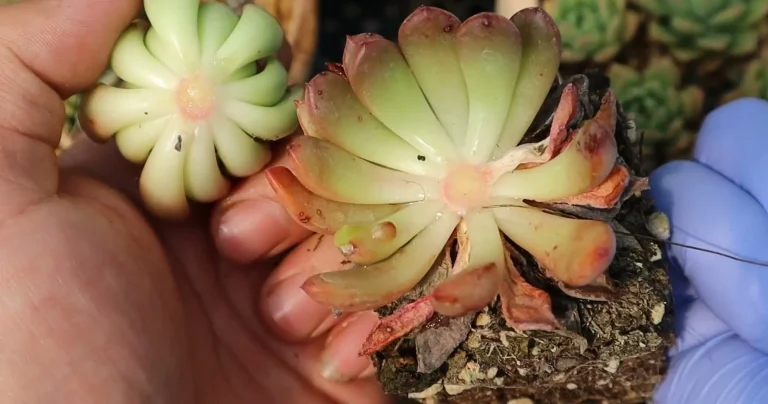
Every leaf cutting starts with getting the leaf off whole. Pinch an outer leaf close to the stem and rock it gently left and right. It comes away easily this way, and the growing point stays in one piece.
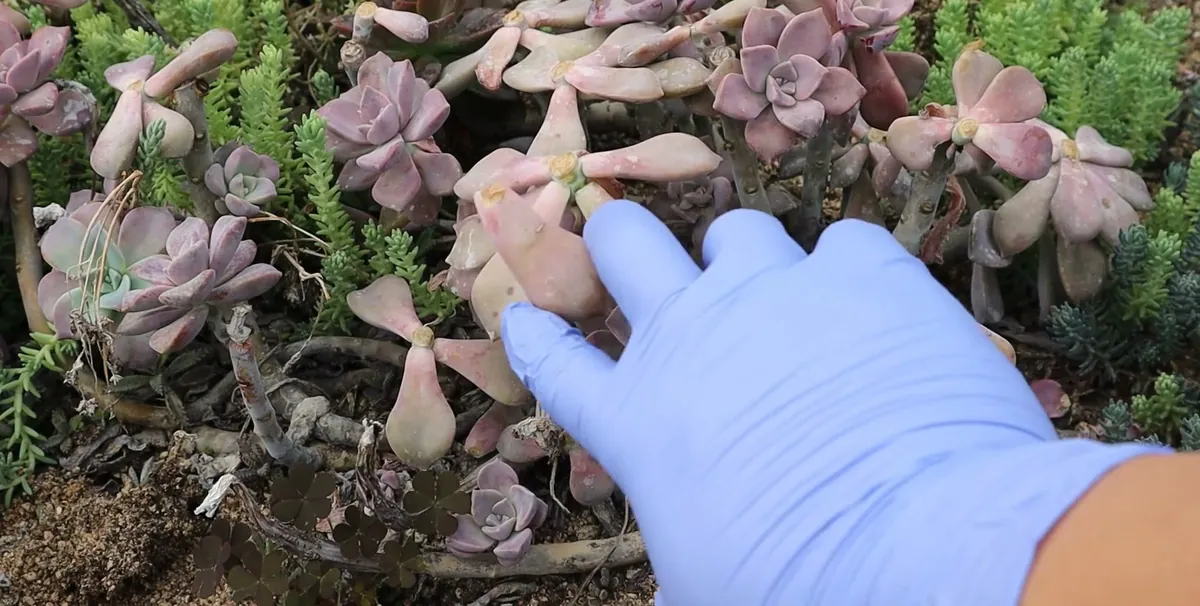
Don’t bend the leaf up and down. That motion snaps the growing point very easily, and on most succulents a leaf with a broken growing point can’t be used. If a leaf feels stuck, keep rocking it instead of pulling harder. Outer leaves are the easiest to start with, because you can get your fingers underneath them without knocking the neighboring leaves.
How to check the base of a succulent leaf
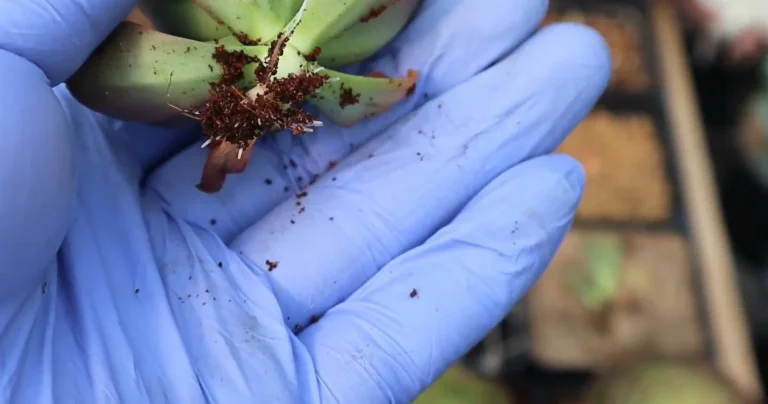
A leaf that came away cleanly can still be a dud, so I turn each one over and look at its base before it goes anywhere near the soil. There are three things you’ll find there:
- An intact growing point. The end of the leaf is whole and clean. This leaf is worth laying out.
- A blackened growing point. The base has gone black, and that leaf won’t work.
- A snapped base. The leaf broke as it came off. These generally won’t root or sprout.
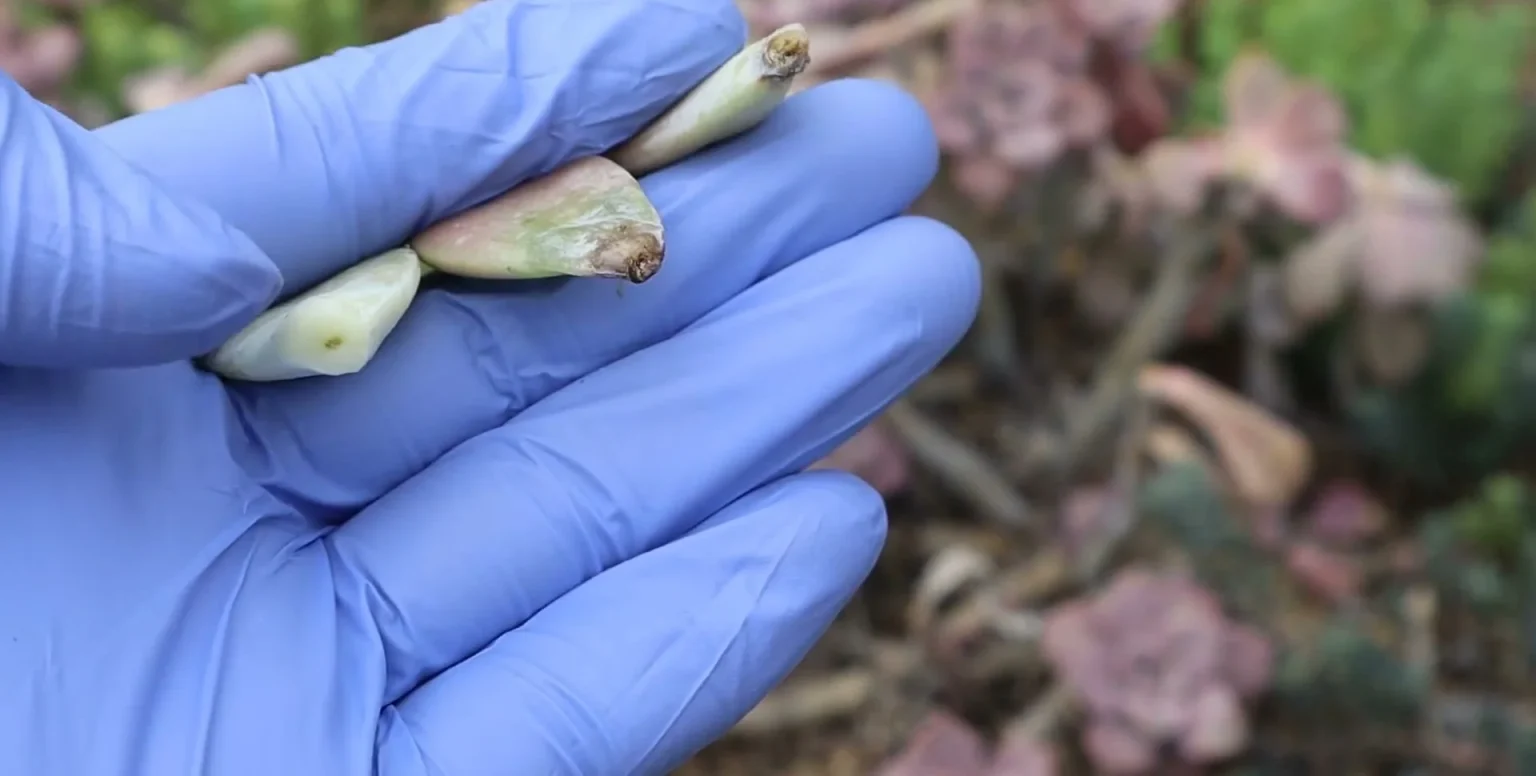
Some kalanchoes are the exception. They can sprout normally even with a damaged growing point, and I’ve seen half a broken leaf push out a little side shoot right beside the wound. Anything else with a bad base gets tossed aside, because it would only take up room on the bed.
How to lay succulent leaves on a soil slope
With the good leaves sorted, the bed needs one small change before they go down. Press a long bar across the soil to shape a shallow dip with a slight slope to it. The slope is so gentle you can hardly see it, and that’s fine. My reasoning for it is simple enough: every leaf ends up lying the same way, its base sits closest to the soil, and the roots that eventually appear don’t have far to travel before they reach something they can grow into.
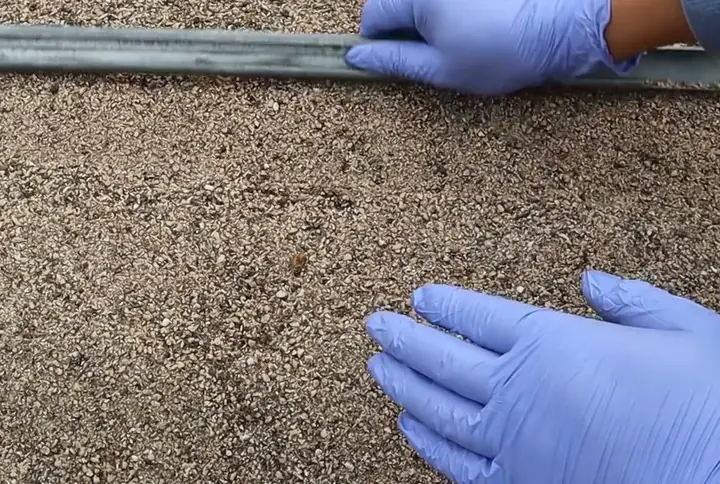
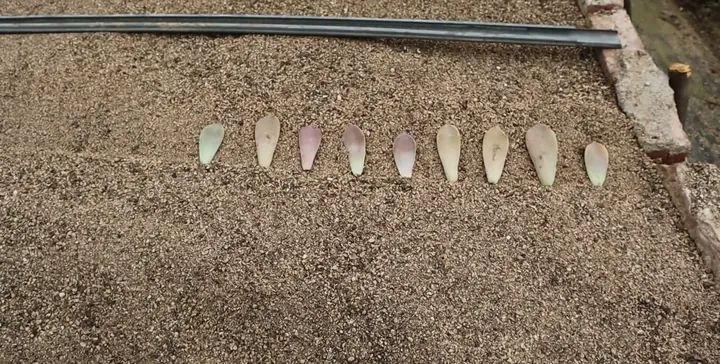
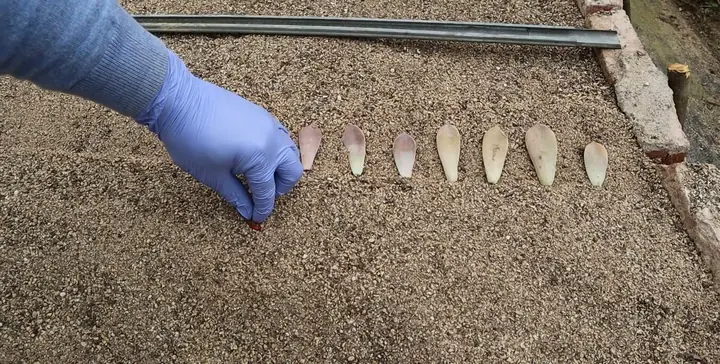
Next, set the unsprouted leaves on that slope one at a time. Lay each one flat on the surface with its narrow base pointing down the slope, and keep the whole row facing the same way. That’s all the planting they get, because nothing is pushed into the soil at this stage.
I leave roughly one leaf’s width between them, judged by eye. Fast-growing varieties get a wider gap, so the young succulents have room to fill out later without crowding each other.
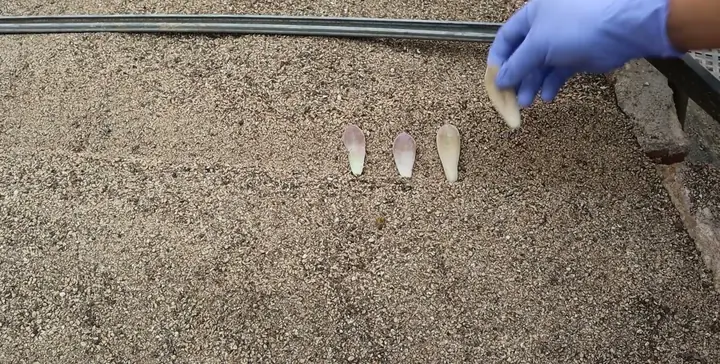
Now leave the row alone and don’t water it. A leaf with no roots has no use for water at all. The wound at each base takes about 1 to 3 days to dry and seal, so keep the leaves and the soil dry through those days.
When to bury the roots of a succulent leaf cutting
After that it’s a waiting game, and the leaves slowly start to root and sprout at the base. They don’t keep to one schedule, so compare yours against my stage-by-stage leaf timeline before you worry. It also says when I give up on a leaf, and it follows the slow months when a rosette takes over from its old leaf.
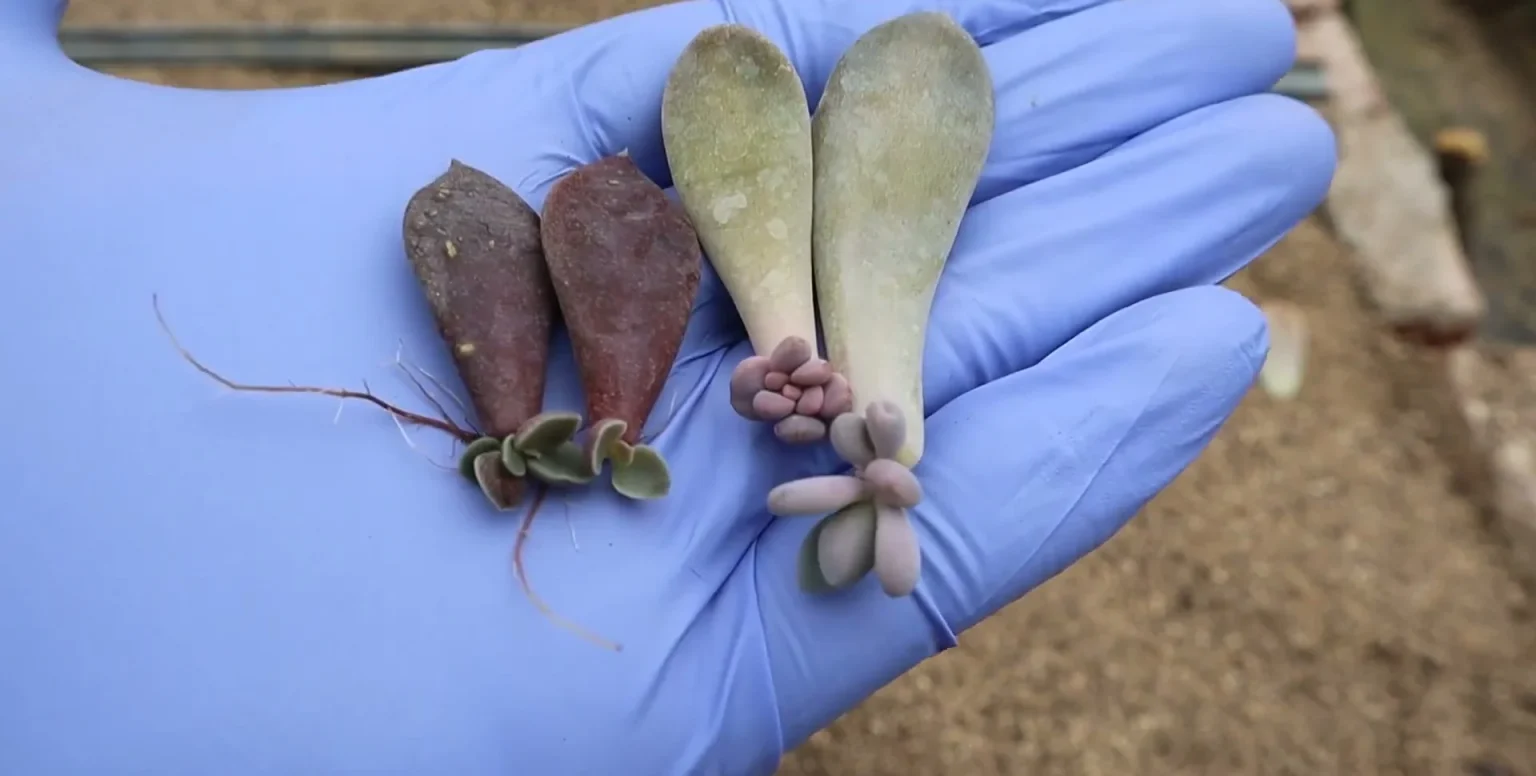
Roots are the signal that the soil finally matters. Some leaves push their roots down into it on their own, and those need nothing from me. Others leave their roots lying on the surface, so I cover just the roots with the surrounding soil and keep the leaf and its rosette above ground.
Why succulent leaves curl and how to plant a curled leaf
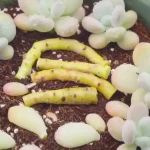
One problem can turn up during that wait, and it stops the roots from ever reaching the soil. Leaves sometimes curl as they sit, often from sun on them, and sometimes for a reason I can’t pin down. Some only begin to bend, while others go right over into a U shape.
The trouble is where the base ends up. On a badly curled leaf it points up at the sky, and the roots would have to grow for a very long time before they touched soil. Waiting that out is pointless.
Straightening the leaf by hand isn’t an option, so change its position instead. Pick the leaf up and set it into the soil at an angle, with the roots pointing down. Even a full U will root this way.
Rooting succulent leaves in a tray with no soil
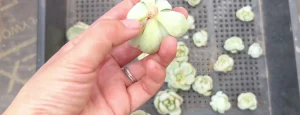
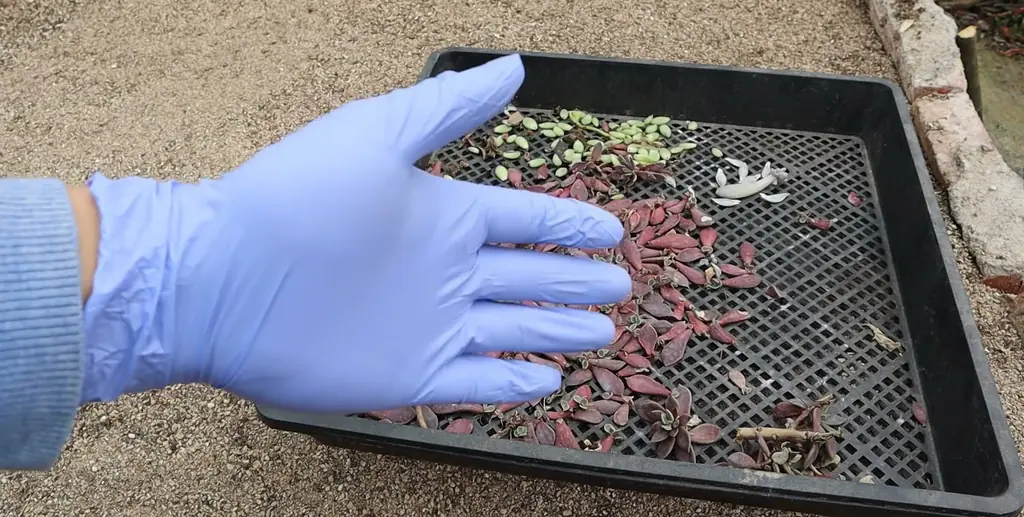
The bed method is the careful way to do it, and it isn’t the only way. With most of my leaves, I skip the soil until they’ve rooted. They stay in the mesh tray in a shady, airy spot, and I don’t touch them. Leaves I strip off while beheading a rosette can go straight in with them.
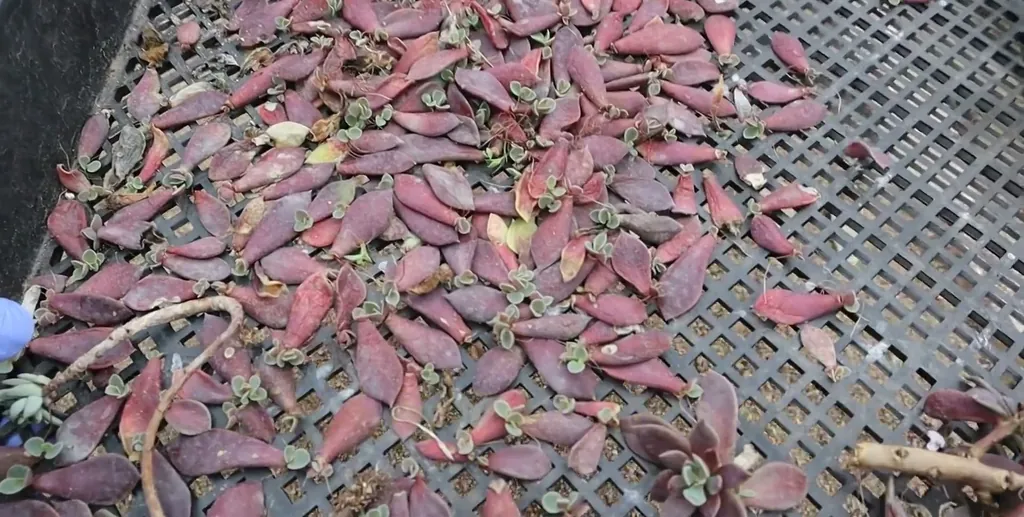
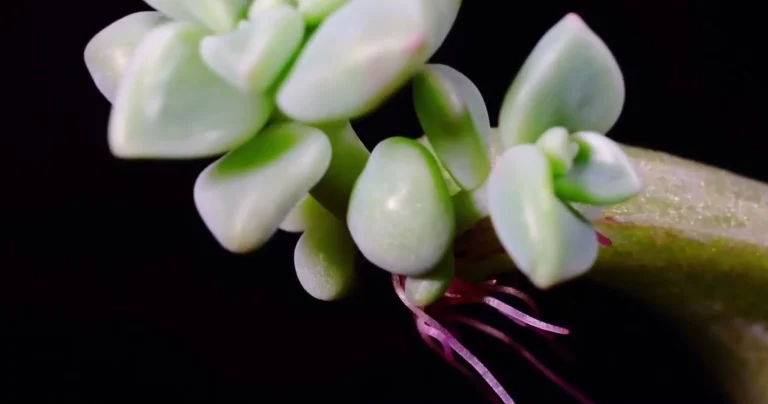
The leaves in this tray were picked a long time ago. Once they’ve rooted and sprouted like this, I bury the roots in soil, and they grow especially fast from there. What I like about the tray is that every base stays in plain view, so I can pick out the rooted leaves and leave the stragglers without disturbing anything else.
There’s a rougher way still, which you’ve probably seen before: throw the leaves on the ground and walk away. I’ve done that on open soil, and easy-growing varieties don’t mind at all. I’d only try it with leaves I can afford to lose.
Succulent leaves with roots but no sprout, or a sprout but no roots
Whichever way you start them, some leaves won’t do both jobs at once. These are the two uneven results I see, and only one of them needs any real help.
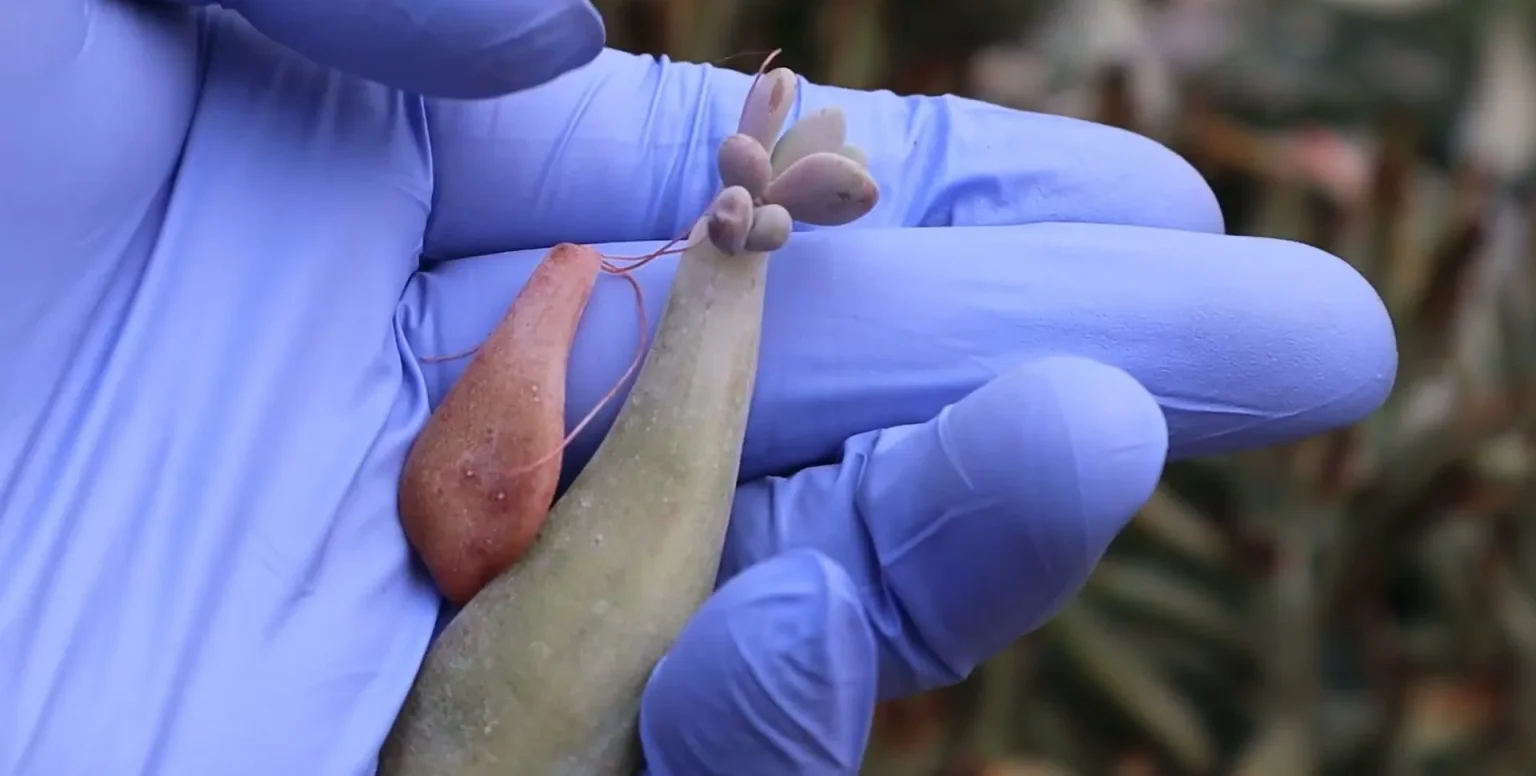
Roots but no sprout
This one’s simple. Bury the roots in soil the same way as any other rooted leaf, and the rest is up to the leaf. I don’t do anything else to it.
A sprout but no roots
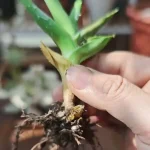
A leaf that sprouts and doesn’t root is usually short of humidity in the air around it. I rarely see this on my roof, because southern China stays damp enough that plants, succulents included, grow aerial roots quite readily. Those are roots that form in open air, and they depend on that moisture.
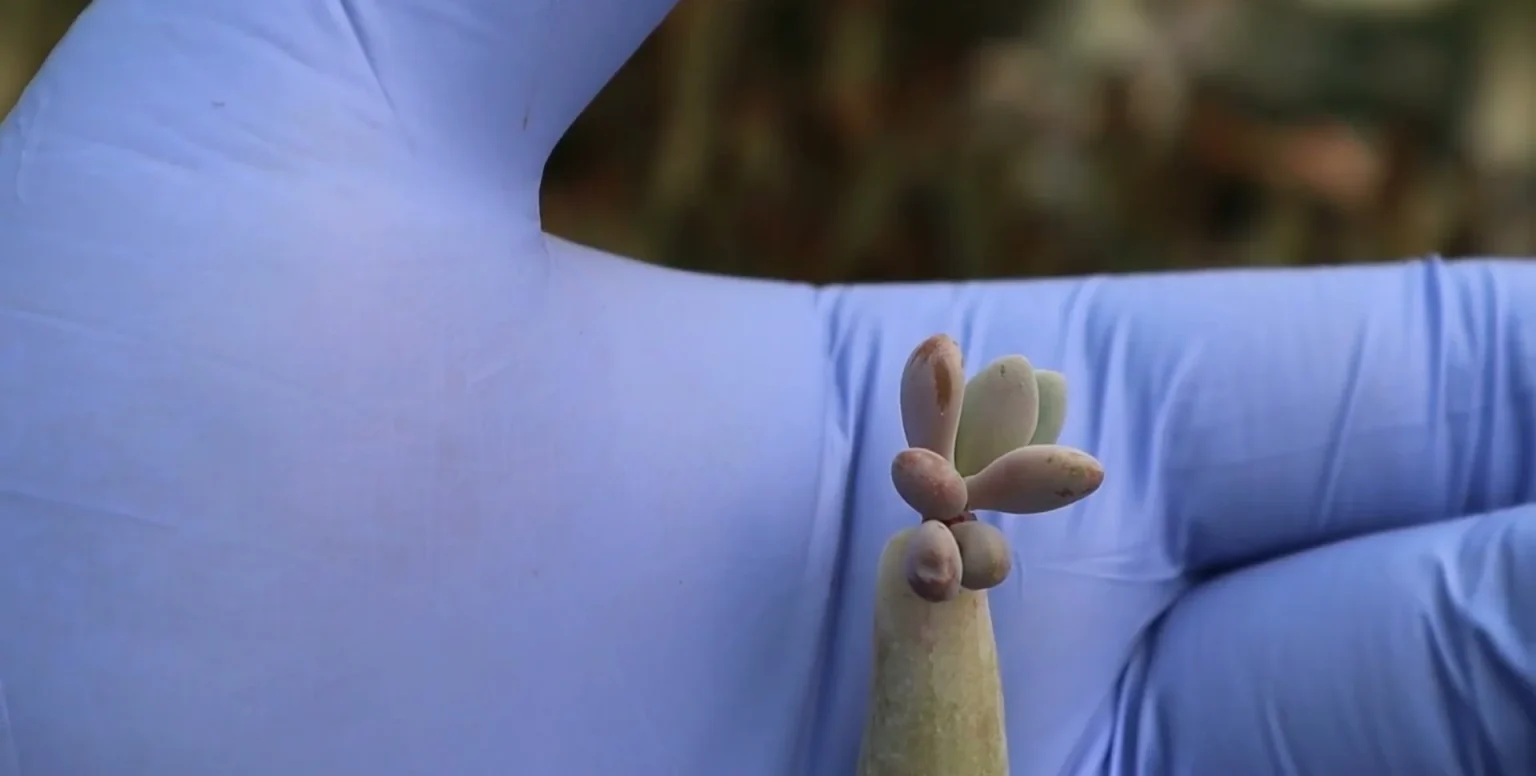
Dry air works the other way, so a grower in Arizona should expect this more often than I do. Indoor conditions in winter can be just as dry, especially near a heating vent. The fix is to raise the humidity around the leaf, and I do that one of two ways:
- Water the soil nearby. A little water in the soil keeps the air damp for longer.
- Spray around the leaf. It’s quicker, but the effect doesn’t last as long.
My page on watering succulents explains why spraying the air is about humidity, and why it doesn’t count as watering. This is the one time water goes near an unrooted leaf, and it’s there for the air.
Common questions about succulent leaf cuttings
These are the questions that come up most once the leaves are down.
Can you root succulent leaf cuttings in water?
Succulent leaf cuttings can root when held just above water, but roots grown that way come out thin and weak, and many don’t survive the move to soil. I start mine on soil or in a dry tray instead.
Do succulent leaf cuttings need to be buried?
No, the leaf itself stays on top of the soil. Only the roots go under, and only once the leaf has grown them.
How do you replant a succulent leaf with no roots?
Don’t push a rootless leaf into the soil. Lay it flat on the surface, keep it dry, and wait for the roots to show.
What do leaf cuttings need after the roots are buried?
Give them bright shade, and a light watering each time the soil has dried. My care pages for grown succulents are all linked from the Succulent Primer homepage.