Gear pick
Best Soil for Succulents: 5 Bags to Buy and the Grit Ratio
Quick answer
The best soil for succulents is a mix where grit makes up at least half the pot: pumice, lava rock, perlite or fired clay granules, with a smaller share of peat, coir or bark. You can buy that ready-made, or buy a cheaper peat-based cactus mix and stir in the grit yourself.
I found that halfway line by growing the same handful of succulents for a year in mixes from 10% to 100% grit. Below are the five bags I’d pick on Amazon, then what that year showed me, how much grit to add, how to read a soil bag, and how to water a gritty pot.
Best succulent soil to buy, sorted by how much grit is in the bag
As an Amazon Associate I earn from qualifying purchases.
Every bag of succulent soil sits somewhere on one scale: how much of it is mineral grit, and how much is organic matter that holds water. I sort the bags that way because in my test pots the grit share decided which plants survived.
| Bag | What the listing says is in it | Grit already in it | Who it suits |
|---|---|---|---|
| Bonsai Jack Jacks Gritty Mix #111 | Bonsai Block, Monto Clay, pine fines | Most of the bag | Indoor growers and anyone who tends to overwater |
| Molly’s Succulent Potting Mix | Pumice, black and red lava, akadama, hyuga, orchid bark | Most of the bag | Small pots of plants that rot easily |
| Hoffman 10404 Cactus and Succulent Soil | Compost, peat moss, sand, limestone | Some sand | A cheap base you plan to add grit to |
| Miracle-Gro Succulent Potting Mix | Sphagnum peat moss, forest products, plant food | Very little | A base with feeding built in, grit added |
| Espoma Organic Cactus Mix | Sphagnum peat moss, humus, perlite, mycorrhizae | Some perlite | An organic base, with more grit added |
Gritty succulent mixes you can pot into straight from the bag
Bonsai Jack Jacks Gritty Mix #111 is the bag I’d buy if I didn’t want to mix anything. The listing names three parts: Bonsai Block and Monto Clay, both fired clay granules, plus pine fines. Bonsai Jack says it tunes the mix to about pH 5.5.
The same mix comes in 2-quart and 1-gallon bags. Its drawback is how fast it dries. In my test, the 100% grit mix lost the most plants under my sparse watering, so I’d only use a mix this gritty on its own if you water often or grow indoors.
Molly’s Succulent Potting Mix is the other gritty bag worth a look. Its listing names pumice, black and red lava, akadama and hyuga, both Japanese clay granules, plus orchid bark. There’s no garden soil in it at all.
The catch with Molly’s is cost. It sells in 3- and 5-dry-quart bags, and per quart it’s the priciest of the five here. I’d keep it for small pots and for the soft-leaved rosettes that rot first when a pot stays wet.
Peat-based cactus and succulent mixes that need grit added
Hoffman 10404 Organic Cactus and Succulent Soil Mix is the cheap, widely sold bag. Its ingredient list reads compost, peat moss, sand and limestone, so most of what’s in it holds water.
I wouldn’t plant a succulent in Hoffman straight from the bag. As a base for mixing, though, it’s a sensible buy, and a 10-quart bag covers a whole shelf of repotting.
Miracle-Gro Succulent Potting Mix is peat moss and processed forest products with Miracle-Gro plant food mixed in. Miracle-Gro says one 4-quart bag fills one 8-inch (20 cm) pot. The built-in food lets you skip feeding for a while after repotting, but the mix needs a lot of grit added.
Espoma Organic Cactus Mix lists peat moss, humus and perlite, plus Espoma’s mycorrhizae blend. Perlite already in the bag puts it a step ahead of the other two, though peat and humus still lead the list. On Amazon it usually sells as a two-pack of 4-quart bags.
Pumice and perlite for making a bagged mix grittier
Pumice is the grit I’d add first. Cz Garden Pumice Stone Grow Media is horticultural pumice, OMRI Listed for organic growing and sold as pH-neutral. Each stone holds a little water inside and keeps its shape for years.
Perlite is the cheaper, lighter option. Miracle-Gro Perlite comes as two 8-quart bags, enough to turn several bags of peat mix gritty. It contains Miracle-Gro plant food, though, so mixing it into the Miracle-Gro succulent soil doubles up the fertilizer.
Perlite has two smaller faults as well. It floats to the surface when you water, and over a few years it crushes down into powder, so a perlite mix slowly gets denser.
What a year of testing succulent soil mixes showed me
My grit test is the reason I sort bags by grit and not by brand. I lined up a handful of succulents, one kind of plant to a row, and potted each row into mixes from 10% grit up to 100% grit.
Each row also got one pot of pure peat and one of pure coir. Then I left them on my rooftop from one April to the next and watered every pot the same way, sparingly.
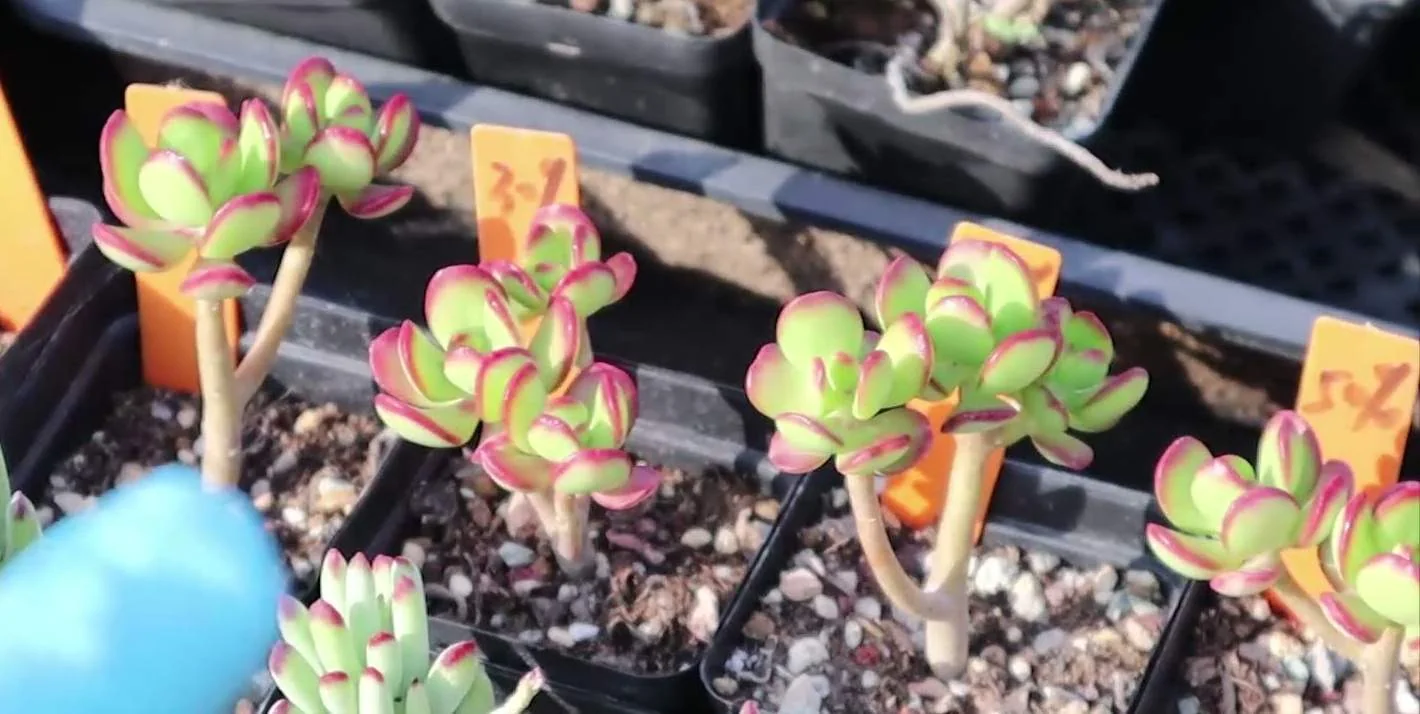
At the end of the year, only the 50%, 60% and 70% grit mixes still had every plant alive across every row. Every other mix had lost something. The 100% grit mix lost the most, and most of those losses came over the summer.
I don’t take that to mean pure grit is a bad soil. Pure grit didn’t suit the way I water, and a grower who waters more often might see the opposite. What the test did show is that a proportion of half to two-thirds grit gave me the most tolerance for mistakes.
The color comparison surprised me more. After a year, the 20% grit pot and the 100% grit pot looked almost the same, with the same tint and the same compact shape. Look very hard and the 100% plant is a touch more translucent.
In the photo below, the left pot is the 20% grit mix and the right pot is the 100% grit mix. You can see the brown organic part between the stones on the left and almost nothing but gravel on the right.
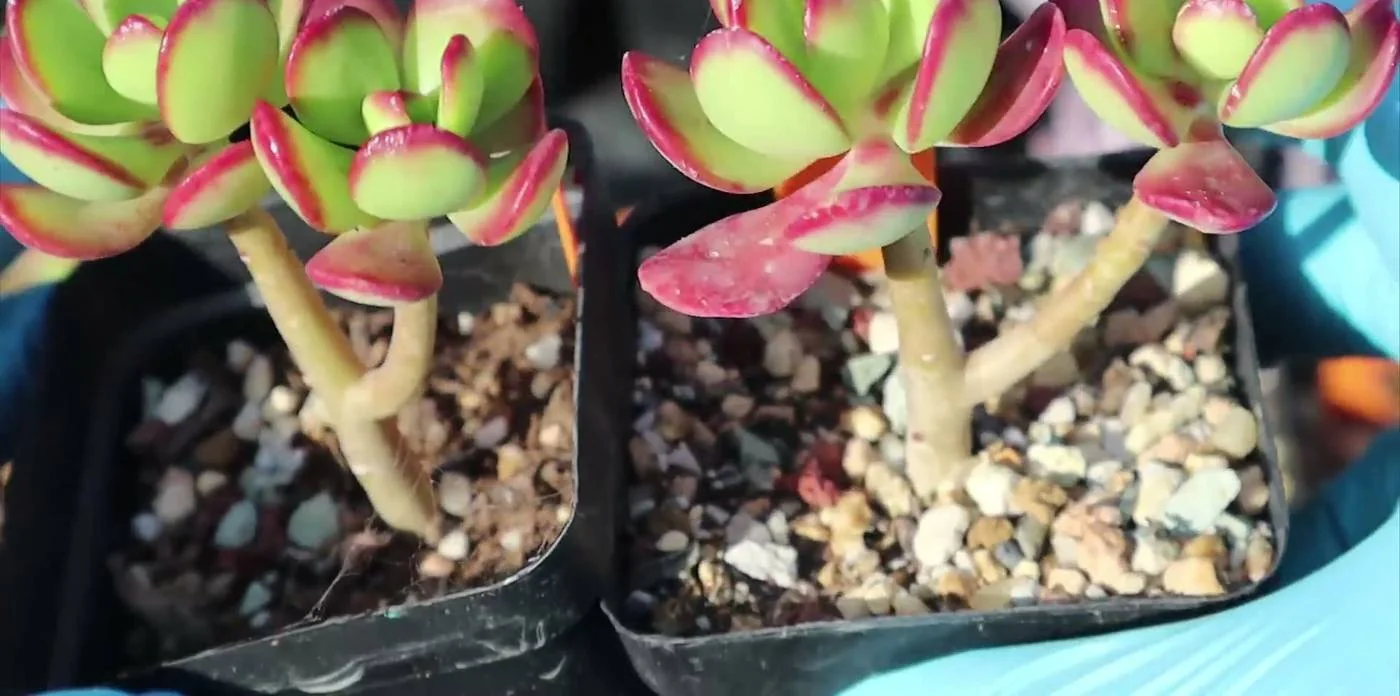
The 90% pot did color up slightly better than the 20% and 50% pots, because it dried out faster after each watering. So the soil itself wasn’t what made those plants red. Watering and light did.
During a long run of rainy weeks that year, most of the other succulents on my roof faded to green. The test pots stayed dry and held their color. Kept that lean, they also grew very slowly, and a whole year added only a little size.
At the end I tipped every pot out and laid the plants in rows to compare their roots. The Oscularia had grown so many roots that they were tangled into one mat.
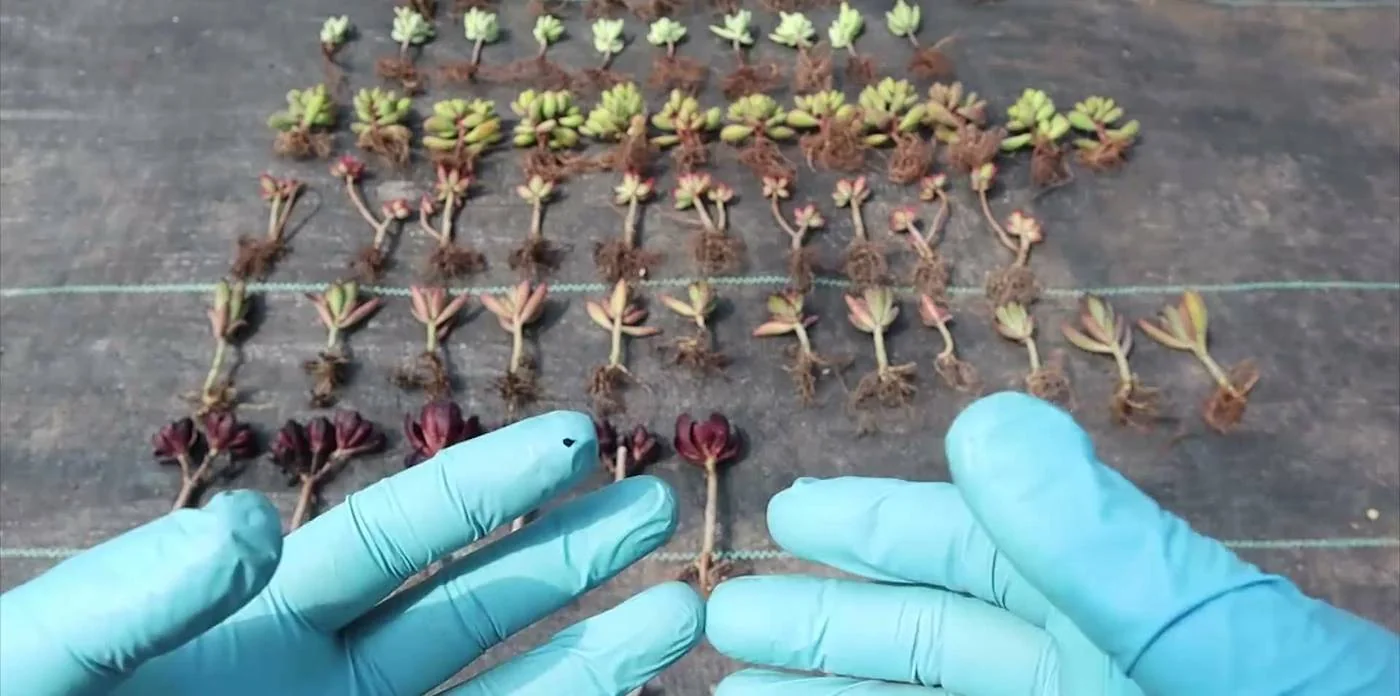
The Crassula rogersii, the hens and chicks and the Oscularia survived every mix, even pure peat and pure coir. The losses came from the other varieties, and one of those was dying in pure coir. Roots tell you more about a soil than leaves do, and I show how to read them in my cactus root guide.
How much pumice or perlite to mix into bagged succulent soil
To bring a peat-based bag into that 50% to 70% range, I mix one part bagged soil with one or two parts grit, measured by volume with the same scoop. One to one gives you half grit. One to two gives you about two-thirds. For cuttings I go to the gritty end: I root them on a barely damp gritty mix, then plant them in about seven parts grit to three of peat.
Where you grow decides which end to aim for. Indoors, pots dry more slowly because there’s less light and moving air, so I’d go grittier. Outside, where summer humidity and rain can last for weeks, as they do on my roof, I’d also lean grittier.
The one-to-one end suits small pots in a hot, sunny, dry spot, where a very gritty mix can dry out within a day. Regular indoor potting soil works as a base too. It holds even more water than a cactus mix, so give it the grittier ratio.
Whatever ratio you pick, the pot needs a drainage hole. Even the grittiest mix can’t dry out when the water has nowhere to leave, and a layer of rocks at the bottom of a pot without a hole doesn’t fix that.
What the ingredients on a succulent soil bag do: peat, coir, compost and grit
Once you’re aiming for half to two-thirds grit, any bag’s ingredient list tells you how far it is from that. Here’s what each common ingredient does in a succulent pot:
| Ingredient | What it does | What to watch |
|---|---|---|
| Peat moss | High water retention; stays damp for days | Turns hard to rewet once it dries out completely |
| Coconut coir | Holds water like peat and carries almost no nutrients | My pure coir plants grew the smallest of the test |
| Compost or humus | Adds nutrients and holds water | Breaks down over time, and the compaction squeezes out air |
| Pine bark or orchid bark | Holds some water while leaving air gaps | Breaks down slowly over a few years |
| Pumice | Porous stone that holds a little water inside | Stays in one piece |
| Perlite | Light, cheap and opens up the mix | Floats up when watered and crushes over time |
| Lava rock | Rough stone with lots of air space | Heavy in large amounts |
| Fired clay (akadama, Monto Clay, Turface) | Granules that soak up water and release it slowly | Akadama softens and crumbles over the years |
| Sand | Only coarse sand helps | Fine sand fills the gaps and packs the soil down |
Coir is sold as a peat substitute, so people often ask whether cocopeat suits succulents. In my test, the Crassula rogersii in pure coir came out much smaller than the same plant in pure peat.
Coir alone gave those roots almost nothing to feed on. A little of it mixed with plenty of grit is fine.
Ingredient order helps too. Labels usually list the biggest share first, so a bag that opens with “peat moss” is mostly peat, whatever the front of the bag calls it.
Watering succulents in gritty soil: why runoff from the drainage hole isn’t enough
Gritty soil and dried-out peat share one problem: water can run straight through them without soaking in. When a pot has been bone dry for weeks, the first pour finds the gaps between the grit and the edge of the pot and drains out of the hole.
Pull the plant out after that first pour and you’ll often find dry soil in the middle. A trickle from the drainage hole only tells you the water found a way out.
What I do is water once, wait about an hour, and water again. For a pot that’s very dry, I stand it in a tray of water and let it soak up from below. I take it out the same day, because a succulent left standing in water for a day or two gets damaged roots.
How much of the pot I wet depends on the plant. A freshly potted succulent gets water around its base so the new roots find it. During summer heat and winter cold, when most of mine are resting, I pour only one or two rings around the edge of the pot until they start growing again.
Succulent soil questions: nursery soil, cheap mixes and where to buy
Should I repot a new succulent out of its nursery soil? Yes, in most cases. Nursery succulents usually come in a peat-heavy greenhouse mix that stays waterlogged far longer at home. Within a week or two of buying one, I shake that plug loose and move the plant into a gritty mix, because roots left sitting in it tend to stall.
Is cactus soil the same as succulent soil? On store shelves, mostly yes. Hoffman and Espoma both sell “cactus” mixes labeled for succulents too. Christmas and Thanksgiving cacti are the exception: these forest cacti want more organic matter, so I give them less grit.
What’s the cheapest way to make succulent soil? Buy one bag of peat-based cactus mix and one bag of perlite or pumice, then mix them yourself. Per quart that costs much less than a premixed gritty blend, and one bag of perlite stretches across several bags of soil.
Where can I buy succulent soil? Amazon carries all five bags above. Home Depot, Lowe’s and Target list peat-based cactus mixes too, so a cheap base bag is easy to pick up locally while you order the grit separately.