Is an Aloe Plant a Cactus? Aloe vs Cactus, and How to Tell
Quick answer
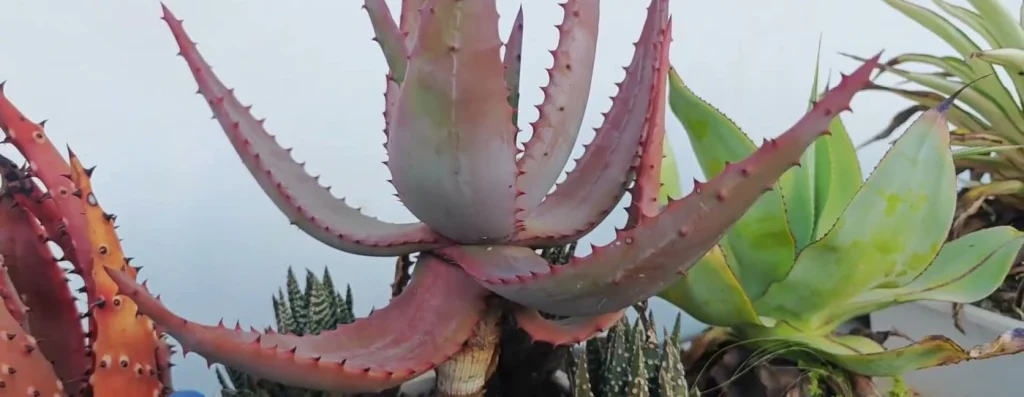
If your aloe has a row of sharp points down every leaf, it’s easy to file it under cactus. It isn’t one. An aloe plant is a succulent in the genus Aloe, family Asphodelaceae, while cacti make up a separate family, Cactaceae, that grows wild only in the Americas; aloes come from Africa, Madagascar and the Arabian Peninsula. Both store water in thick, fleshy tissue, which is why they look alike and end up on the same shelf at the garden center.
Below I’ll cover what separates the two families, why aloe “spines” are not cactus spines, three checks you can run on your own plant, the lookalikes that muddy things, and what changes when you grow aloe next to cacti.
Aloe vs cactus: two different plant families
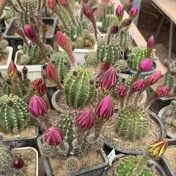
Every cactus is a succulent, but most succulents are not cacti. “Succulent” describes a way of living: thick, juicy leaves or stems that hold water through dry spells. “Cactus” is a family name, and only plants in Cactaceae carry it; what that family includes is in my cactus guide. Aloe has the succulent habit without the family membership.
The two aren’t close cousins, either. Aloes are monocots, the branch of flowering plants that also holds grasses and lilies, and sit in the order Asparagales, the same broad group as agave, asparagus and orchids. Cacti are eudicots, the larger branch that holds most broad-leaved plants, in the order Caryophyllales, next to carnations, beets and ice plants. They look alike because two unrelated lines of plants arrived at the same answer to drought: store water, cut down on surface area, and arm yourself against anything that wants to chew on that water.
Older books file aloe under the lily family (Liliaceae), and you’ll still see that on some plant tags. Current classification puts it in Asphodelaceae, together with its small relatives haworthia and gasteria.
| Aloe | Cactus | |
|---|---|---|
| Family | Asphodelaceae | Cactaceae |
| Wild range | Africa, Madagascar, Arabian Peninsula | The Americas (one species, Rhipsalis baccifera, also grows wild in Africa and Sri Lanka) |
| Where it stores water | Thick leaves | Swollen stem; most have no working leaves |
| Sharp parts | Teeth on the leaf edges and tips | Spines in clusters from areoles |
| Flowers | Tubular, on a tall stalk above the leaves | Open directly on the stem, from an areole |
| New plants | Pups from the base | Offsets or branches, often from areoles along the stem |
Aloe teeth are not cactus spines
The spiky edge is what fools most people. I call them spines myself out of habit, and so does almost everyone who grows aloes. Botanically they’re teeth: small hard points that are part of the leaf margin, the way a serrated edge is part of a bread knife.
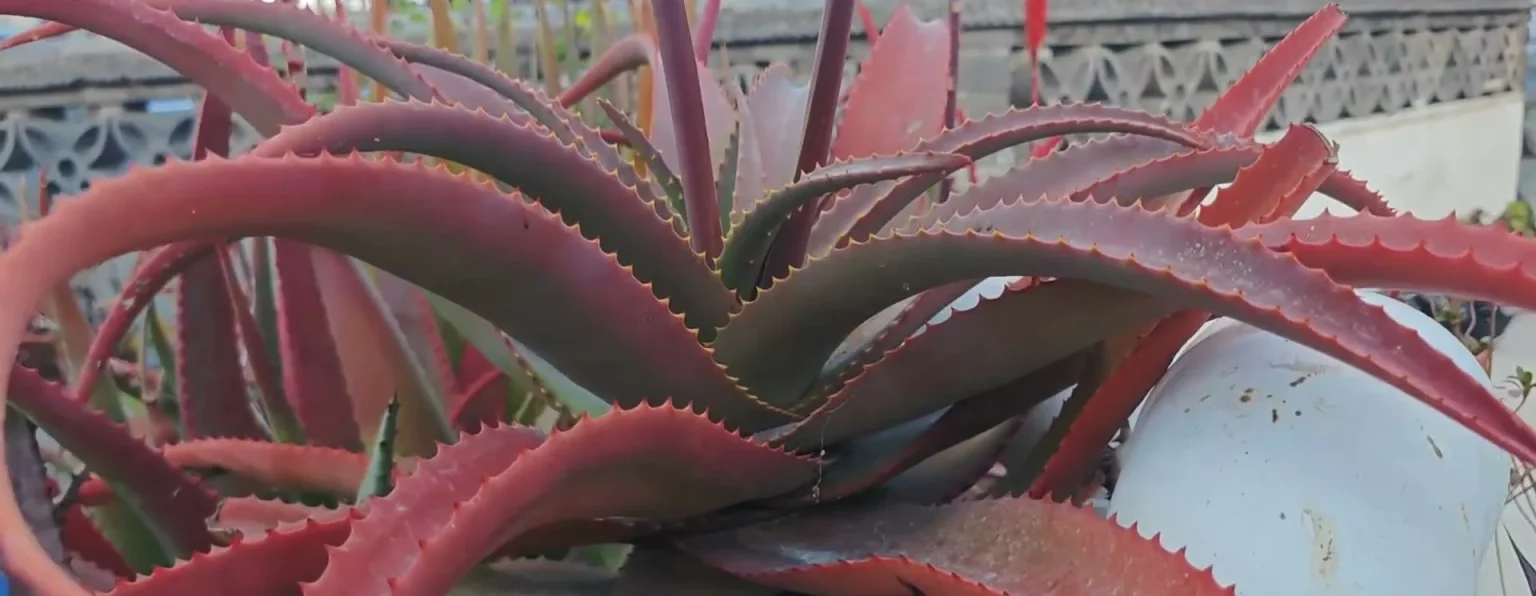
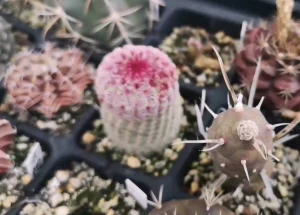
A cactus spine is a different organ. It grows out of an areole, a small cushion on the stem that often looks woolly or fuzzy. Each areole puts out a cluster of spines, and the same spot can later push out a flower or a new branch. Aloes have no areoles anywhere. Follow an aloe leaf from base to tip and the teeth sit in one row along the edge, spaced out, with plain leaf in between.
Teeth vary a lot from one aloe to the next: some are red, some yellow or white, some soft enough to brush past, some hard enough to snag a sleeve. A few aloes, Aloe ferox and its hybrids among them, also carry prickles scattered over the leaf faces. Those are still bumps on a leaf, single and rooted in the leaf skin, not clusters coming out of a cushion.
How to tell if your plant is an aloe or a cactus
Once you know what an areole looks like, most plants sort themselves out in under a minute. I check three things, in this order:
- Where the sharp bits grow. A single row along the leaf edges, maybe a point at the tip, means aloe or one of its relatives. Clusters of spines coming out of fuzzy dots spread over ribs or bumps mean cactus. No spines at all doesn’t rule out a cactus: many forest cacti, like the Christmas cactus, have areoles with only a few tiny bristles.
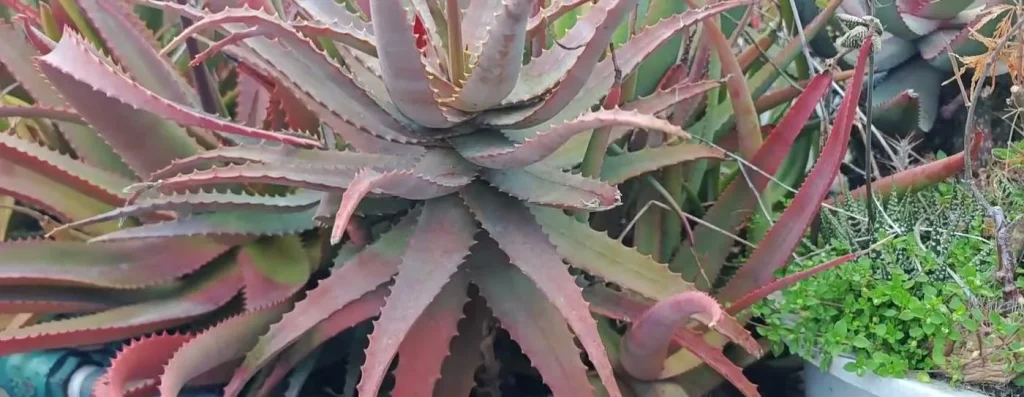
- Leaves or stem. On an aloe, the green parts are leaves. Some aloes grow as a flat rosette with every leaf coming out of one center point; others build a taller, layered shape as new leaves stack above old ones on a short trunk. Either way you can follow each leaf back to where it attaches. On a cactus, the green body is the stem itself, a ball, column or pad, and there is no separate leaf to trace.
- Where new plants come from. Aloes push pups up from the base, and each pup grows its own roots. When I split aloe pups, the roots are thick and fleshy, almost like thin, pale carrots, and I can tease them apart by hand. Cacti make offsets too, but they often appear higher up, out of areoles on the stem.
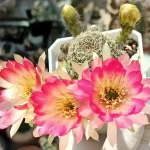
If your plant blooms, the flowers settle it. An aloe sends up a tall stalk well above the leaves, topped with a spike of narrow, tube-shaped flowers, usually red, orange or yellow. A cactus flower opens right on the body of the plant, out of an areole, often with many petals and a wide face.
Plants that get mixed up with aloe and cactus
The three checks handle most plants, but a few keep landing in the wrong bin. You’ll also see pots tagged “aloe cactus” at big stores. That’s a sales label, not a plant name. If the plant under that tag has fleshy, toothed leaves coming from a center point, it’s an aloe, and the checks above will confirm it.
- Agave. The one most often confused with aloe. Agaves also form rosettes of toothed leaves, but they end each leaf in a hard, needle-sharp tip spine, and the leaves are stiff and fibrous rather than gel-filled. Agave belongs to yet another family, Asparagaceae, and most kinds flower once and then die. It isn’t a cactus either.
- Haworthia. Small rosettes, often with white bands or bumps, that people mistake for baby aloes or tiny cacti. They’re aloe relatives in the same family and grow happily in the same pots.
- Gasteria. Thick, tongue-shaped leaves, often rough to the touch and stacked in two rows. Another aloe relative, same family.
- Columnar euphorbias. These are the plants that look most like cacti, ribbed columns with spines and all. The giveaway: their spines come singly or in pairs straight from the ridge, with no fuzzy areole, and a cut or broken stem bleeds white, milky sap. That sap irritates skin and eyes, so wear gloves when you handle them.
Growing aloe next to cacti: what changes
Since both are succulents, the basics overlap: a gritty, fast-draining mix, a pot with a drainage hole, and water only once the mix has dried out. I keep aloes and cacti on the same rooftop and water them on the same rough rhythm through the warm months. Aloe’s fleshy roots rot just as fast as any cactus’s if they sit in soggy mix.
The differences show up in light and in winter. Most desert cacti want all the sun you can give them. Aloes are content with a little less: indoors, a bright east-facing window is enough, and in a hot summer a south window or full afternoon sun can scorch the leaves into dull brown patches.
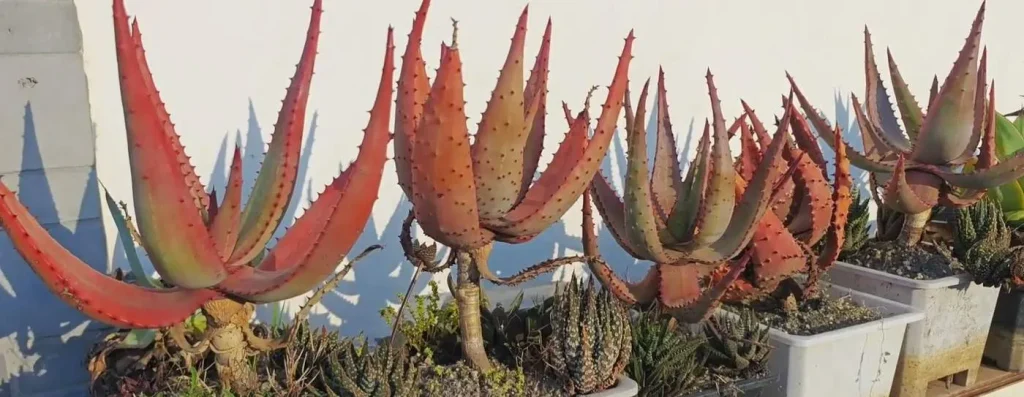
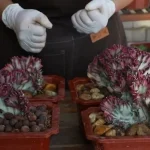
Cold, bright weather is when aloes put on a show. After roughly two months of nights around 35–40°F (2–4°C), toothed aloes like these turn red, coral or plum, and a smaller pot pushes the color further. That red is a stress color, not damage, and the leaves go back toward green once warm-season growth picks up. A hard freeze is a different matter, so move aloes under cover before frost. My rooftop in Huizhou rarely gets that cold, so mine only blush at the tips.