Cactus Scale: How to Identify and Get Rid of Scales on Cactus
Quick answer
Cactus scale is a small sap-sucking insect that sits on the skin as a fixed tan, brown or gray bump, and the edge of a plastic plant label will show you whether that’s what you’ve got. To get rid of it, scrape the bumps off, hose the stem hard, then spray a horticultural oil or insecticidal soap whose label covers scale and your plant. One round won’t finish the job. The University of Wisconsin says soap or oil usually takes at least three treatments, repeated every six to seven days.
Below I go through telling scale from other marks, the eight steps on a badly infested column, how to handle the repeat rounds, the white cottony kind on prickly pear, and why it comes back.
How to tell scales on cactus from other marks
Scale is easy to miss because it doesn’t look like a bug. There are no legs or head to see, just a little waxy dome or disc that stays put. UC IPM, the University of California’s pest program, describes scales as small, brown or grayish and mostly stationary, and University of Wisconsin Extension puts them at 1/16 to 3/8 inch (about 2 to 10 mm) across.
On a cactus, look first around the areoles, the fuzzy pads the spines grow from, and down the grooves between the ribs. Then slide a plastic edge under one bump and push sideways. Scale comes away and leaves the skin in one piece.
| What you see | Plastic edge test | Most likely |
|---|---|---|
| Tan, brown or gray bumps sitting on top of the skin | Pops off | Scale |
| Dark brown dots under a thin layer of skin | Doesn’t lift; digging leaves a pit | Fungal spots |
| Firm tan, rough skin starting at the soil line | Doesn’t lift; it is the skin | Corking |
| White tufts that look like cotton | Smears or wipes away | Mealybugs or cochineal scale |
Those fixed brown marks need a different answer. Skin that’s turning woody from the base up is probably corking, the harmless aging of an older cactus, and spots buried in the skin belong to the guide on fungicide for cactus spots.
Sticky skin is a useful clue. UC IPM separates the two common groups this way: armored scales are flat, don’t make honeydew (the sugary liquid scales excrete), and have a cover that usually comes off and leaves the body behind. Soft scales are rounder, make honeydew, and their cover won’t lift off alone. Shine, black sooty mold or ants on the plant all point toward a soft type.
You don’t need the species to start. I can’t name the one on my own column, and scraping doesn’t care. The damage to expect is yellowing and stunted growth, and parts of the plant can distort or die back when numbers get high.
What you need to treat cactus scale
Everything here is cheap, and the first two items do most of the work:
- A white plastic plant label, or any stiff plastic tag with a narrow tip
- A hose with an adjustable nozzle
- Plastic sheeting to lay under the plant
- A horticultural oil or insecticidal soap with scale on the label, and your plant type too
- Cotton swabs and isopropyl alcohol at 70% or less, for spots the label can’t reach
- Thick gloves if the spines bother you
Move the pot well away from your other plants before you begin. Young scales are the stage that walks, and in some species they ride the wind to the next plant, so a clean neighbor won’t stay clean for long.
Check the plant’s water too, because Colorado State University Extension warns that plants under drought stress are at higher risk of oil injury. If the stem looks thin or shriveled, give it a normal deep watering and let it dry out before spray day.
How to get rid of scale on a cactus in eight steps
This is the order I used on a blue-green column that had scale on every side: look it over, scrape, hose, spray. Any plant with a bad case can take the same route, and a light case can stop at scraping with a weekly check.
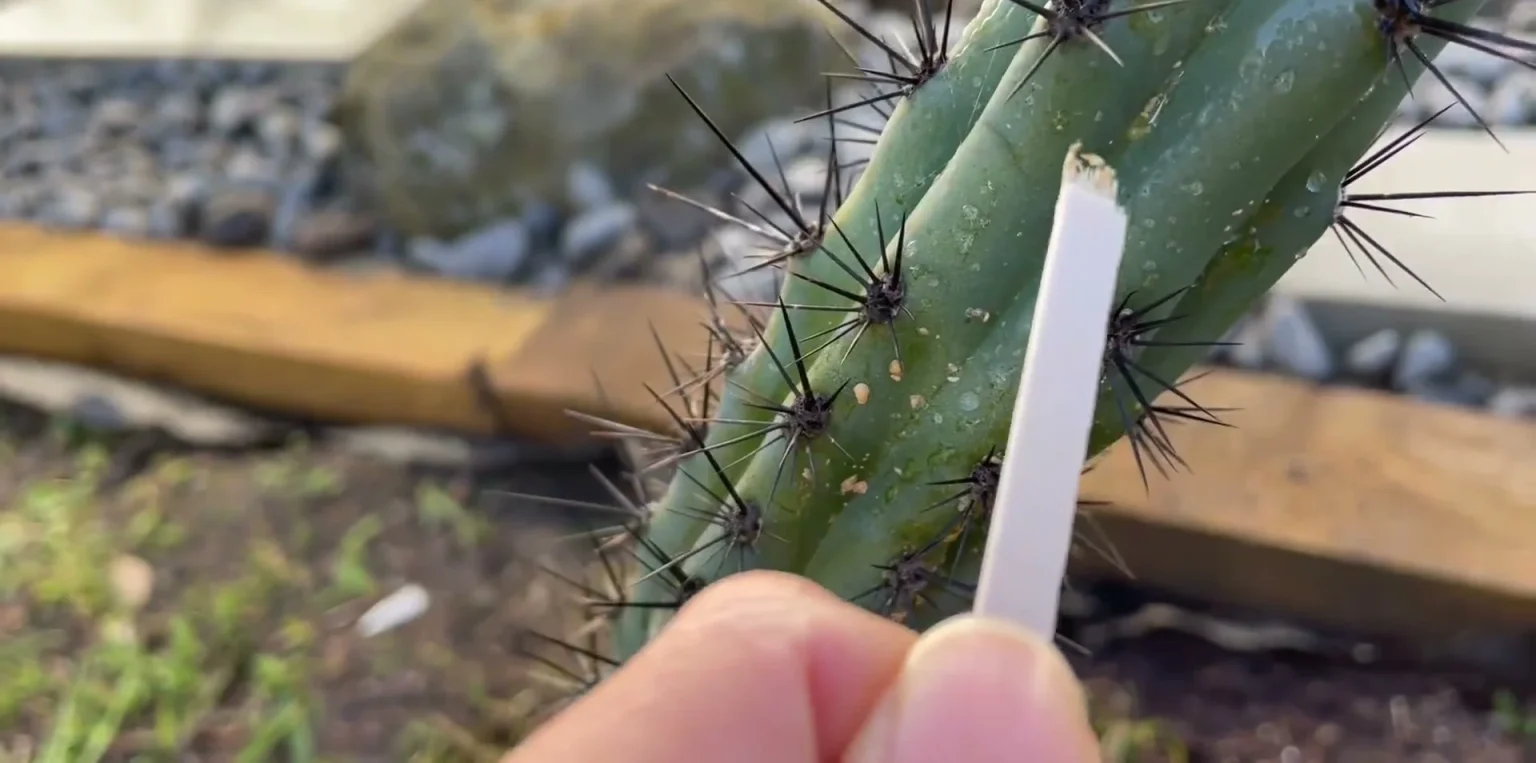
Step 1: Test a few bumps with the label
Hold the label next to the stem and tip one bump off with the corner. Try two or three spots on different ribs, because a single bump proves little.
Step 2: Find where the scale is thickest
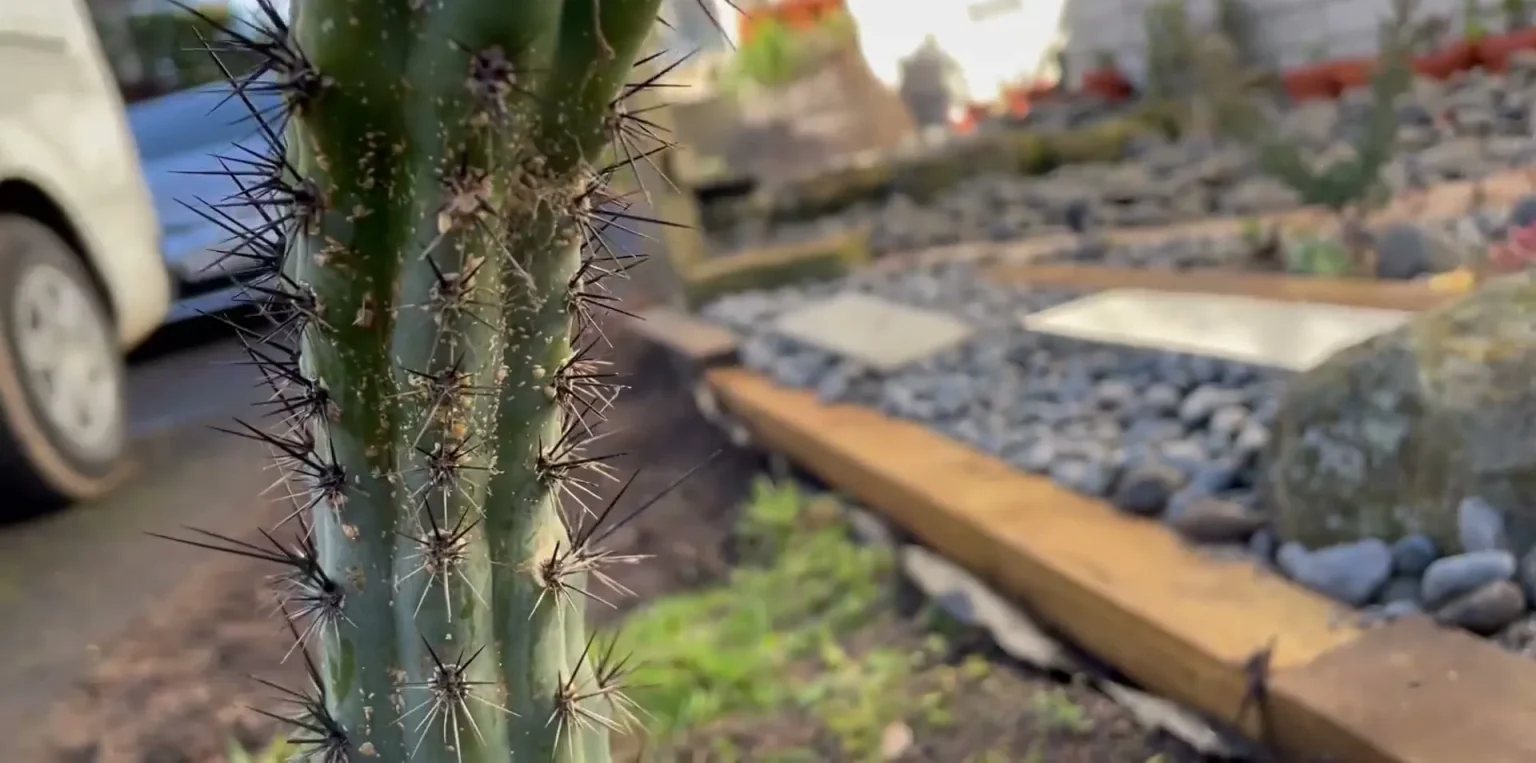
Look straight at the stem and work out where the crowding is. Scale tucks in beside the areoles and runs down the grooves, and mine was heavier on the middle of the column than near the base. That’s where most of your scraping will go.
Step 3: Turn the pot and check every side
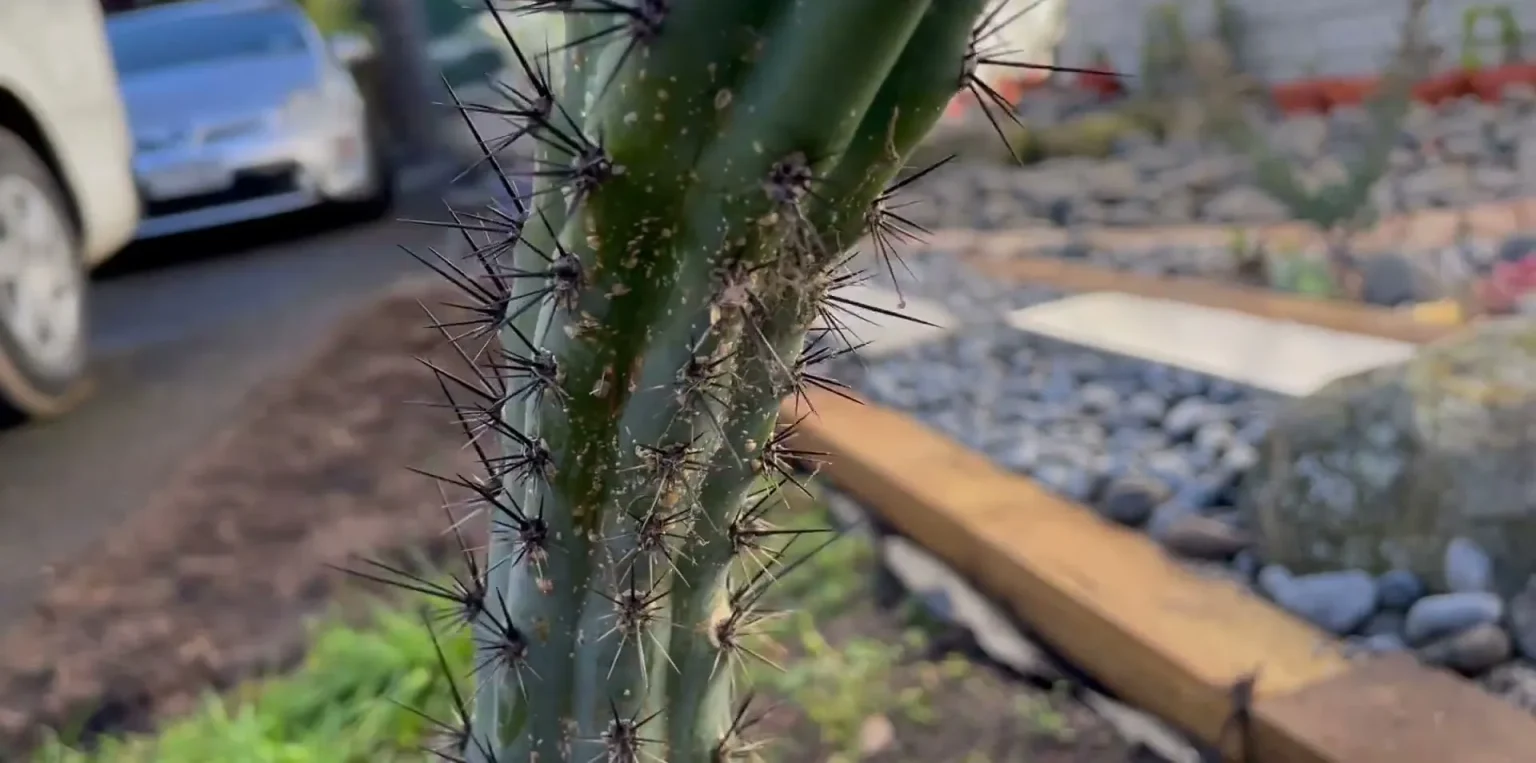
Rotate the plant a full circle before you scrape anything. An infestation rarely stops at the side you noticed, and University of Wisconsin Extension’s advice is to check every part of the plant.
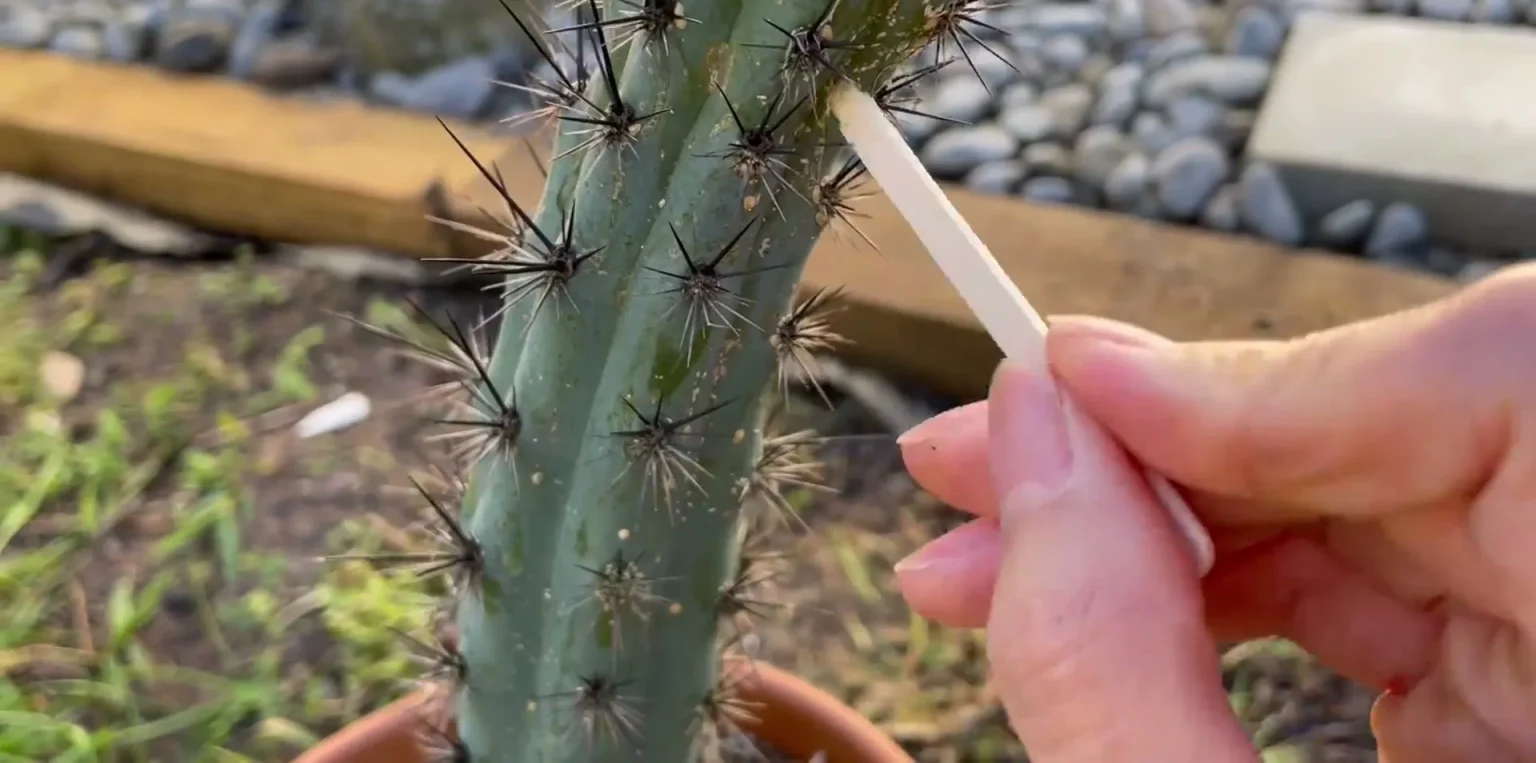
Step 4: Scrape one rib with the label tip
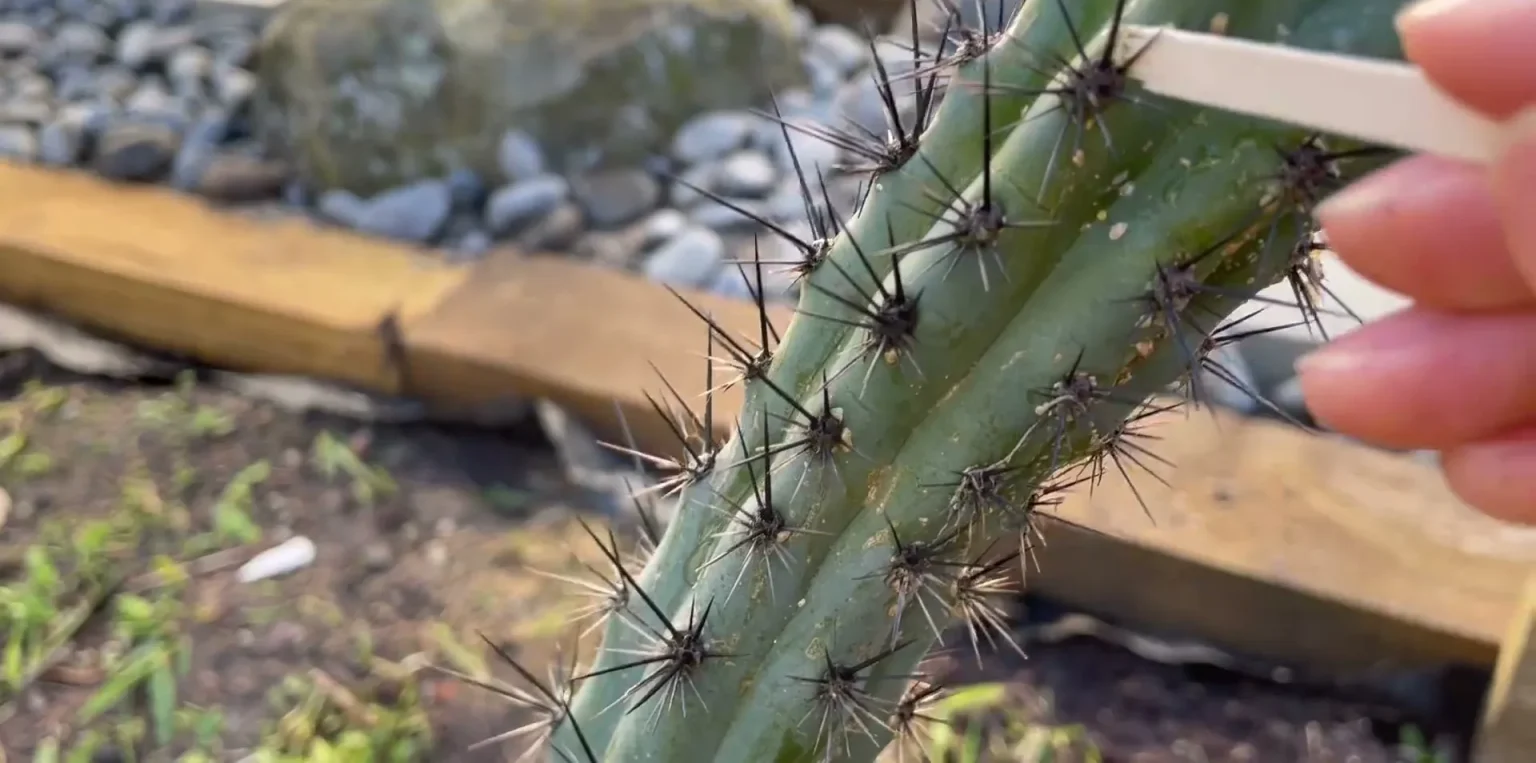
Press the tip against the rib beside an areole and push it along the skin so the bumps flick off. Use plastic and not a knife, since a blade slices the skin and rot can enter through the cut. Keep the pressure light enough that the tip skates over the surface.
Step 5: Work around the stem and down to the base
Go rib by rib, holding the label at a low angle so the tip slips in between the spine clusters. Finish the lower stem as well, even if it looks cleaner. Use a swab dipped in alcohol for anything wedged where the tip can’t go, after testing it on a small area first.
Step 6: Lay the pot on its side and hose the stem
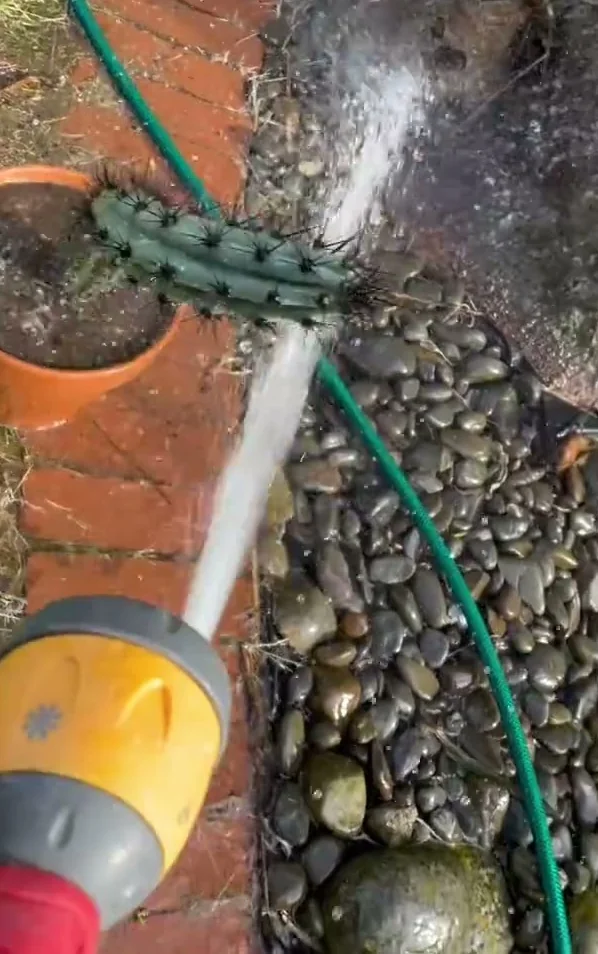
Take the plant outside and tip the pot over so the stem lies across the ground, which lets the water run off instead of filling the pot. Set the nozzle to a firm jet, aim it at the ground first to see how hard it hits, then sweep it along the stem on all sides. UC IPM recommends washing the crawling young off with water, and this also clears the loose scales you’ve scraped.
Step 7: Set the plant by plastic sheeting and read the label
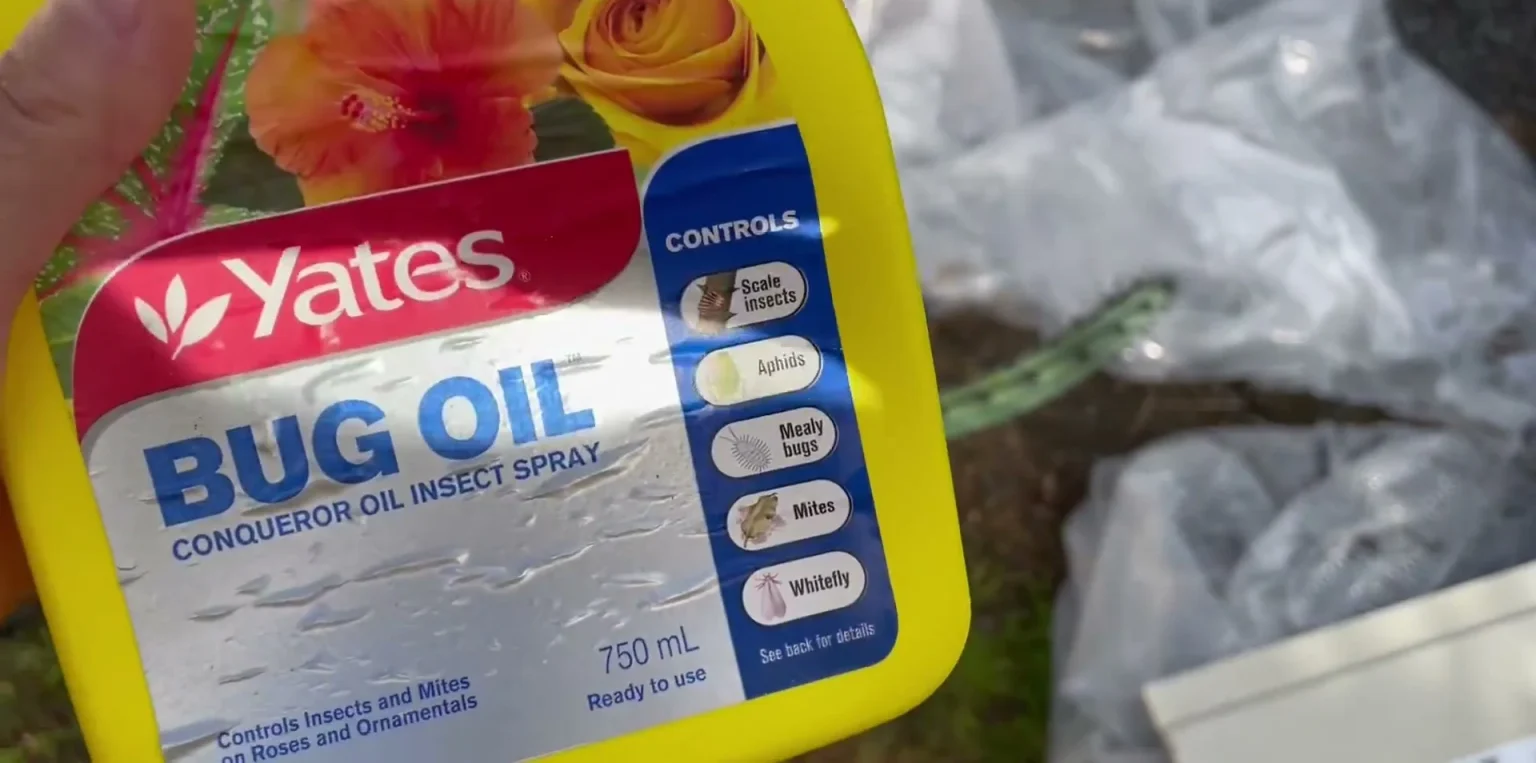
Move the pot beside the sheeting, still on its side. Now read your bottle. It should list scale insects and allow use on your plant, and its directions set the dilution, the dose and the wait between sprays. I’m not giving you those numbers, because they differ from one product to the next.
Three checks go here that are extension advice and not part of my original routine. Wait for the stem to dry, since Colorado State says not to apply oil to wet plant tissue or when rain is likely. Skip the day if it’s freezing, hot or foggy; UC IPM’s limits are under 32°F (0°C) and over 90°F (32°C). Then spray a single rib and give it several days to show any damage, and only after that do the rest. I couldn’t find a US extension source that says how cacti respond to oil, so I treat a small test as the cheap way to find out.
Step 8: Spray the whole stem over the sheeting
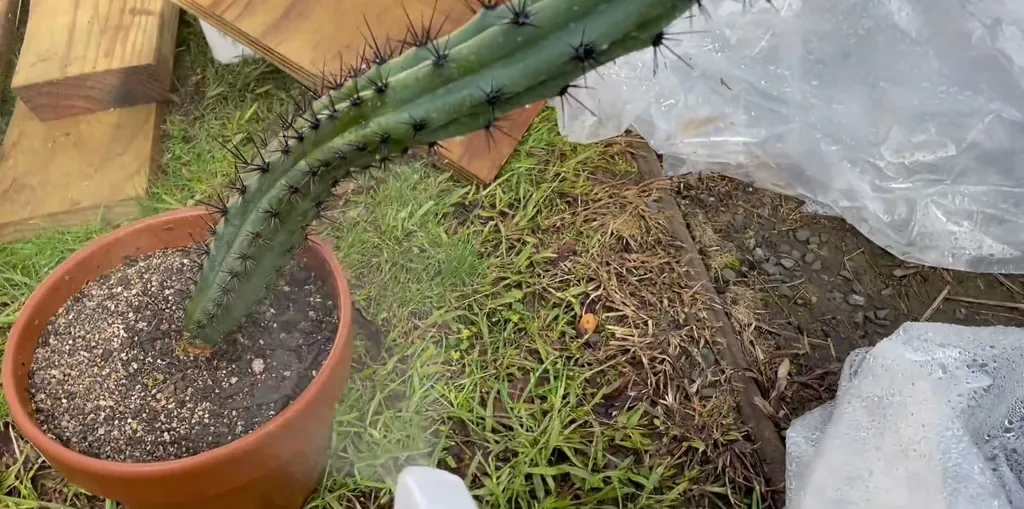
Mist every side of the stem, working the spray in around the areoles and down to the base where it meets the soil. Coverage is the whole point, because oil and soap only work on what they touch. Let the sheeting catch the drift, then stand the pot back up once the stem has dried.
How often to repeat cactus scale treatment
That first spray is only the opening round, because adult scales sit under wax that shields them and the unprotected crawlers are what a spray really catches. University of Wisconsin Extension’s schedule for soap or oil is usually at least three treatments, repeated every six to seven days until the scales are gone. That advice covers scale in general, not cacti in particular, and if your label gives a different interval, follow the label.
Between sprays, go over the plant once a week. Wisconsin suggests the same weekly inspection for lightly infested houseplants, repeating the cleanup as needed, and warns it will probably take several rounds.
Not every bump you find is alive. UC IPM’s check is to squish a few, because dead scales fail to exude fluid. Dry bumps can simply be scraped away, while wet ones mean another round is due.
I don’t have a photo of that column weeks later, so I won’t promise how fast yours will clear. What I can tell you is what clean looks like: no new bumps on two weekly checks in a row. That’s my own rule, not an extension figure.
Marks can stay after that. Skin that spent months under a thick crust of scale has gone brown on me once the insects were off, and a plant can look worse clean than it did infested. Those scars don’t heal, so judge the plant by new bumps and not by old brown patches.
Sometimes the fight isn’t worth it. University of Wisconsin Extension says disposing of a heavily infested plant may be the best solution, though a cherished plant may earn another few rounds. UC IPM’s other option is to cut away the worst parts if they’re limited, which suits branching plants and pads better than a single column.
White scale on cactus: cochineal on prickly pear
White, cottony patches on a prickly pear are a likely sign of cochineal, a different kind of scale from the tan bumps above. Cochineal scales feed only on cacti, UC IPM says, usually prickly pear, and they hide under pale, sticky wax. They often gather around the bases of the spines.
Crushing one settles it. The body is bright red and stains your fingers, while a cactus mealybug has gray body fluid. If it isn’t red, treat it as mealybugs, which have a row of their own in my cactus troubleshooting table.
UC IPM’s plan for a heavily colonized plant has three parts:
- Prune off the most damaged pads and throw them out.
- Wash away the waxy covering with a forceful spray of water.
- Spray insecticidal soap on the bodies you’ve just exposed.
Don’t leave it. A heavy cochineal attack over a long time can stunt a prickly pear and eventually kill it.
Why do cacti keep getting scale?
A return usually traces back to one of a few gaps. Spines and grooves protect a few survivors, and one female left behind is enough, since some soft scales lay 50 to 2,000 eggs or live young depending on species. Stopping after one spray has the same effect, because the crawlers that hatch afterward never met the oil.
New plants are the other route in. Wisconsin’s first line of defense is inspecting plants before you buy, and the wax often blends into the stem, so look closely and keep a new cactus apart from the rest for a few weeks. That wait is my own habit, and it has saved me from worse than scale.
Ants deserve a look too. UC IPM says they feed on honeydew and “farm” sap-suckers, moving them to new plants and guarding them from natural enemies, so a trail of ants on a pot is worth dealing with on its own.
Cactus scale questions
Can scale kill a cactus? It can over time. A few bumps won’t do much, but a heavy infestation left alone can stunt a cactus and cause dieback, and UC IPM says long-term cochineal feeding can kill a prickly pear.
Is rubbing alcohol safe on a cactus? UC IPM’s advice for dabbing houseplants is isopropyl alcohol at 70% or less, tested on a small part of the plant first while you watch for burn. Use a swab on the bumps you can’t reach, and don’t pour it over the stem.
Can I get rid of scale naturally? Scraping and hosing use nothing but plastic and water, and on a light case they may be all you need. For sprays, Colorado State notes that some horticultural oils come from plants, but the same label check applies to those.
Does a systemic insecticide work on cactus scale? It depends on the scale, so I’d leave it as a last resort. UC IPM says soil-applied systemics work against some soft scales, while imidacloprid doesn’t control most armored ones, and they shouldn’t go on plants during or shortly before flowering. Check that the label allows use on your plant.
Will scale spread to my other cacti? It can, through the crawlers. Many scale species stick to particular host plants, so one infested pot doesn’t always mean the whole shelf, but check the neighbors anyway.
Scale can settle on other succulents as well, so the plant you’re checking next may be a jade or an aloe. My notes on the rest of the collection start from the home page.