Jumping Cactus: Why Cholla Jump and How to Remove One
Quick answer
A jumping cactus doesn’t actually jump. The name belongs to the jumping cholla (Cylindropuntia fulgida) of the Sonoran Desert, and it’s also used for its cousin the teddy bear cholla (Cylindropuntia bigelovii). Both have stems built from short segments that snap off at the joints when something brushes them, and their barbed spines hook into skin, fur and shoes so fast that the piece seems to leap. Below I cover which plant is which, where they grow, why the segments break loose, and how to get one off without a handful of spines.
Why the Jumping Cactus Seems to Jump
The plant never moves on its own. What moves is a segment, sometimes called a joint, that has a weak spot where it meets the next one. A light bump from a leg, a dog’s tail or a shoe is enough to break that joint, and the loose piece comes away with whatever touched it.
The spines do the rest. Teddy bear cholla spines run about 1 in (2.5 cm), and each one sits inside a thin, papery sheath that can slip off. The spines also carry tiny backward-facing barbs, which is why they go in easily and come out hard. A segment can lodge in your calf before you notice you’ve touched the plant, and that speed is where the “jumping” story comes from.
The same weakness that gives the plant its protection also handles its reproduction, as the section on new plants below explains.
Jumping Cholla vs. Teddy Bear Cholla: Two Plants Called Jumping Cactus
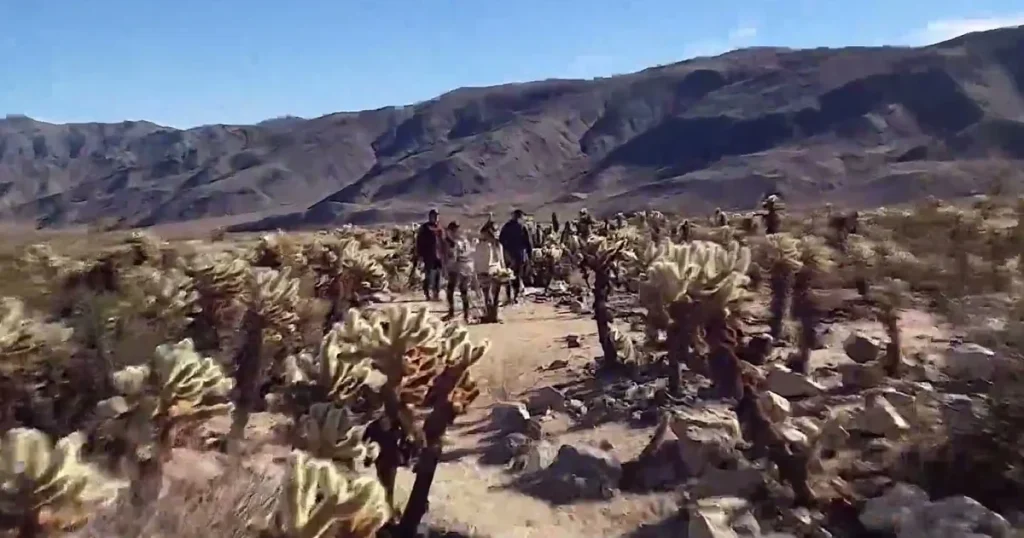
Two cholla species carry this nickname, and the photos on this page show the second one, the teddy bear cholla, at the Cholla Cactus Garden in Joshua Tree National Park. The quick comparison:
| Jumping cholla | Teddy bear cholla | |
|---|---|---|
| Latin name | Cylindropuntia fulgida | Cylindropuntia bigelovii |
| Other names | Hanging chain cholla, chain-fruit cholla | Teddy-bear cholla |
| Typical height | Often about 13 ft (4 m) | 1 to 5 ft (0.3 to 1.5 m) |
| Native range | Sonoran Desert, Arizona and northwestern Mexico | California, Arizona, Nevada and northwestern Mexico |
| Flowers | White and pink, streaked with lavender, about 1 in (2.5 cm) wide | Yellow-green, at the stem tips in May and June |
| Telltale feature | Fruit hanging in long chains | Silvery spines so dense they hide the stem |
The jumping cholla is the taller, tree-like plant. It gets its other name from the green fruits that stay on and sprout new fruit year after year, so they hang in chains. Wikipedia’s page on the species notes that most of those fruits are sterile.
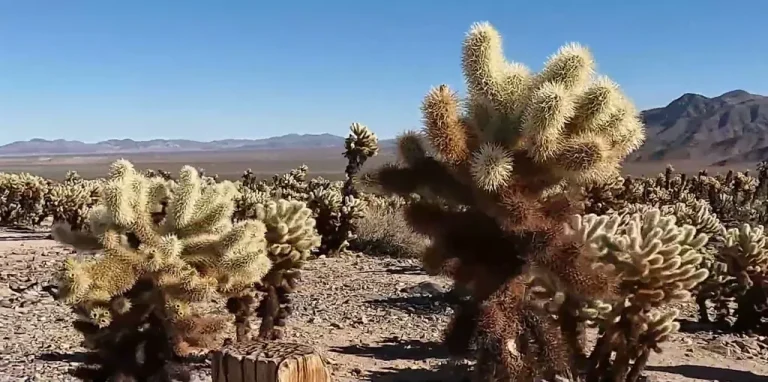
The teddy bear cholla looks soft from a distance, which is how it earned its nickname. Up close, the spines cover the segments almost completely and glow gold in low sun.
Both species belong to the cholla group, the segmented relatives of the prickly pear, and my overview of cactus families for beginners shows how they compare with the globes, paddles and columns you see in garden centers.
Where the Jumping Cactus Grows
Cholla are plants of the hot deserts of the American Southwest and northern Mexico. The jumping cholla grows wild mainly in the Sonoran Desert of southern Arizona and Sonora and Sinaloa in Mexico. The teddy bear cholla reaches farther west and north, into the deserts of southern California and Nevada, usually below about 3,000 ft (900 m).
One of the best-known places to see a dense stand is the Cholla Cactus Garden in Joshua Tree National Park, California. A short trail with wooden fencing runs through teddy bear cholla packed close together, and the plants grow right up to the path edge.
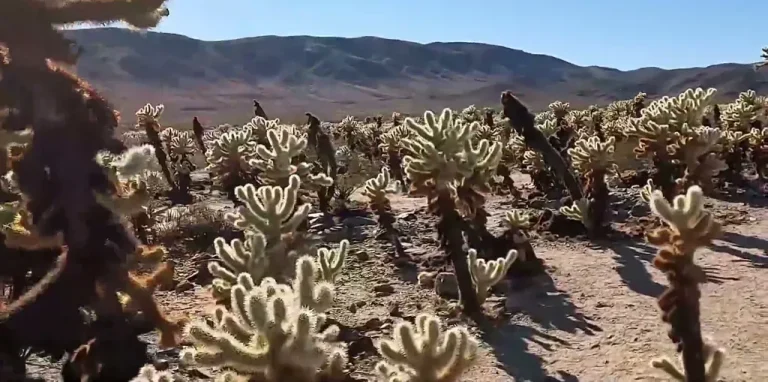
That combination of crowding and loose segments explains the reputation of this particular trail.
How the Detached Segments Grow Into New Plants
Breaking apart so easily isn’t a flaw in the plant. For both species, a dropped segment is the main way of making new plants. A piece that lands on open ground puts out roots and starts a new cholla. A piece that hooks onto a passing animal gets carried a short distance first and then drops off.
Over time, one plant can surround itself with copies, which is why cholla often grow in thick patches rather than scattered singles.
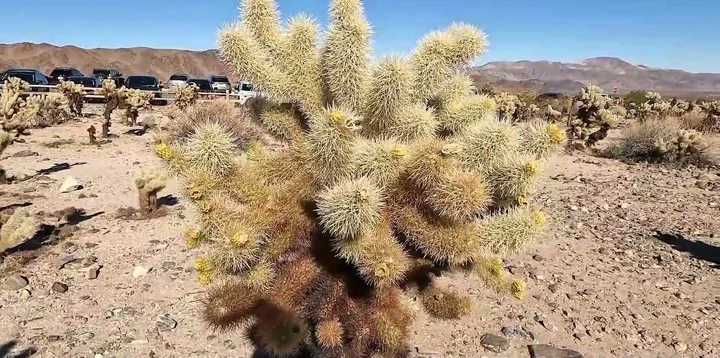
You can read a cholla’s age from its color. The living segments near the top are pale gold or silvery. Lower down, the old stems turn dark brown to nearly black as their spines age and the lower segments drop away. Those dead segments pile up on the ground around the plant, so the sand under a cholla is often scattered with loose pieces that still have their spines.
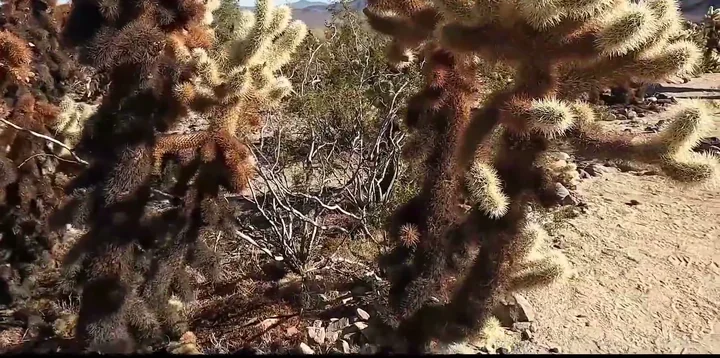
How Painful Is a Jumping Cactus Sting?
A cholla segment usually hurts more than a single cactus spine, because it hooks in with many barbed spines at once, and each one resists when you pull. Pulling also tends to push the segment’s other spines into your fingers.
The pieces on the ground are the ones that catch people out. On the trail at the Cholla Cactus Garden, loose segments lying on the path hook onto the sides of shoes, and they hold so firmly that kicking or stamping won’t shake them off.
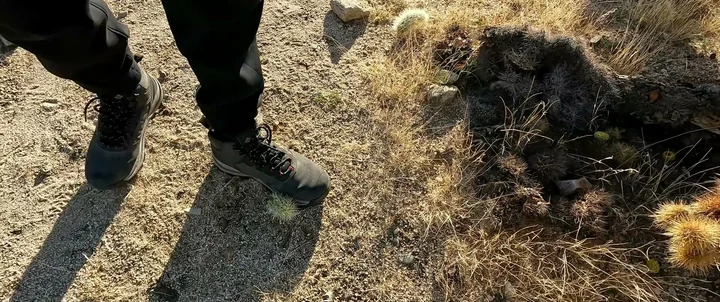
That attachment is the plant’s whole dispersal strategy at work, just aimed at a hiker instead of a passing animal.
How to Remove a Jumping Cactus Segment Safely
Removal is easier than it looks, as long as you never use your bare hands.
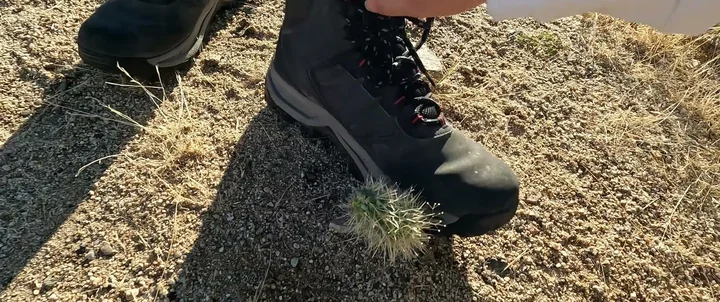
Don’t grab the segment with your fingers, and don’t try to brush it off with your other hand. Both moves only add a second patch of spines. The usual method is a lever:
- Slide a comb between the segment and your skin. A wide-tooth plastic comb works well. Push the teeth in under the segment, as close to your skin as you can.
- Flick the comb away from your body. A quick outward flick pops the whole segment out in one go. Keep your face and other hand out of the line it flies.
- Pull leftover spines with tweezers or pliers. Grip each spine close to the skin and pull straight out along the line it went in.
- Wash the area with soap and water. Then check it again in good light, because the finest spines are easy to miss.
If you don’t have a comb, two sticks or a pair of car keys used as a lever also work. A spine that broke off deep, any spine near an eye, or a spot that keeps getting redder and more swollen over the next few days is worth showing to a doctor. A dog with a segment in its mouth or paw should go to a vet instead of being pulled at home, since it will fight you.
Walking Safely Around Jumping Cactus
Once you know the segments break loose and lie on the ground, the rules for a cholla trail are simple. Wear closed shoes with thick sides, and long pants if you have them. Stay in the middle of the path, because the plants lean right over its edges. Keep dogs on a short leash and children close, since both tend to wander toward the fuzzy-looking plants. Watch the ground as much as the plants, and check your shoes and cuffs before you get back in the car.
A little attention on the way out saves you a painful discovery on the drive home.
Can You Grow a Jumping Cactus at Home?
You can, in a dry, sunny climate or in a pot, as long as you’re ready to handle it carefully. Cholla want full sun, a very gritty, fast-draining mix and long dry spells between waterings. Treat them like any other desert cactus, and give them less water in winter. A cholla stays far smaller in a pot than in the wild, but its segments are just as loose, so keep it out of walkways and away from where pets sleep.
Up on the roof in Huizhou, I keep one small teddy bear cholla in a pot, well away from the path to the water tap. The first time I repotted it, a segment came off onto my sleeve before I’d even lifted the pot, and since then I handle it only with kitchen tongs and a thick folded newspaper wrapped around the stem.
Starting a new plant is as easy as it is in the wild. Pick up a healthy segment with tongs and set it on top of dry gritty mix. Wait until you see new growth before watering lightly. If you’re choosing a cactus for a sunny windowsill, my lists of small cactus plants and tall cactus types have friendlier options. For everything else on my roof, start from the Succulent Primer home page.
Jumping Cactus FAQ
How far can a jumping cactus jump? A jumping cactus can’t jump at all. A segment only leaves the plant when something touches it, so the distance is zero unless you brush past.
Do jumping cactus flowers look like the teddy bear cholla’s? No. The jumping cholla has white-and-pink flowers streaked with lavender, while the teddy bear cholla has yellow-green flowers at its stem tips in May and June.
How do I get rid of a jumping cactus in my yard? Wear thick gloves and eye protection, lift each segment with long tongs or a shovel, and bag it rather than leaving it on the soil, where it can root. Pick up the fallen pieces under the plant too, or new cholla will come back from them.