Sand Dollar Cactus: Flowers, Size, Care and Seed Propagation
Quick answer
A sand dollar cactus is Astrophytum asterias, a spineless, nearly flat cactus from South Texas and northern Mexico that grows to about 6 in (15 cm) across. It’s also called the star cactus, and the United States lists it as endangered, even though seed-grown plants are sold widely. Most have eight ribs dusted with white flecks and yellow flowers that open from the crown. The sections below cover the spot patterns that set the named forms apart, my sowing routine, and the state of the wild plants.
What a sand dollar cactus looks like and how big it gets
The name comes from the shape: a low, round dome with no spines, shaped much like the shell. Wild plants reach about 6 in (15 cm) across but only about 1 to 2.4 in (2.5–6 cm) tall. That flatness has a cost in the wild, where a plant can vanish under soil and leaf litter, and it can sink below the ground surface in extreme drought.
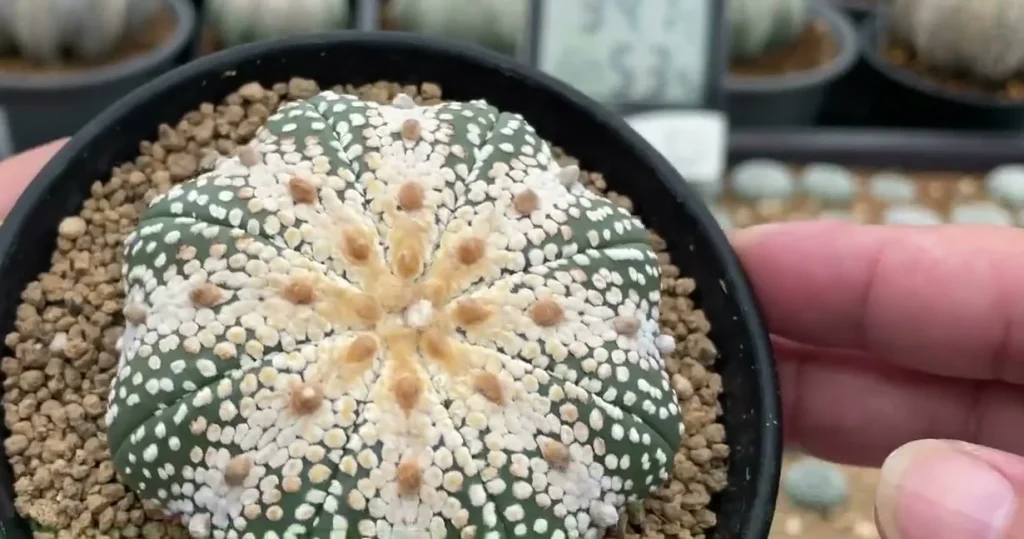
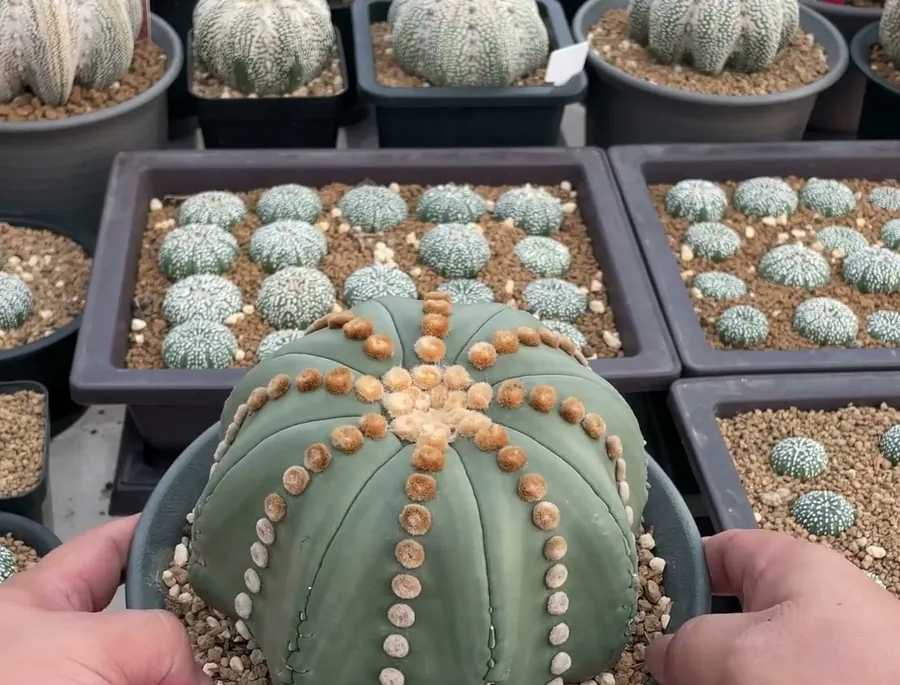
The body usually splits into eight ribs, though the count can run from seven to ten. A line of woolly tan cushions runs down each rib. Those are areoles, the feature every true cactus shares, and on this plant they carry wool where other cacti carry spines. The white flecks between them are tufts of tiny hairs, and they’re the part growers have spent decades selecting.
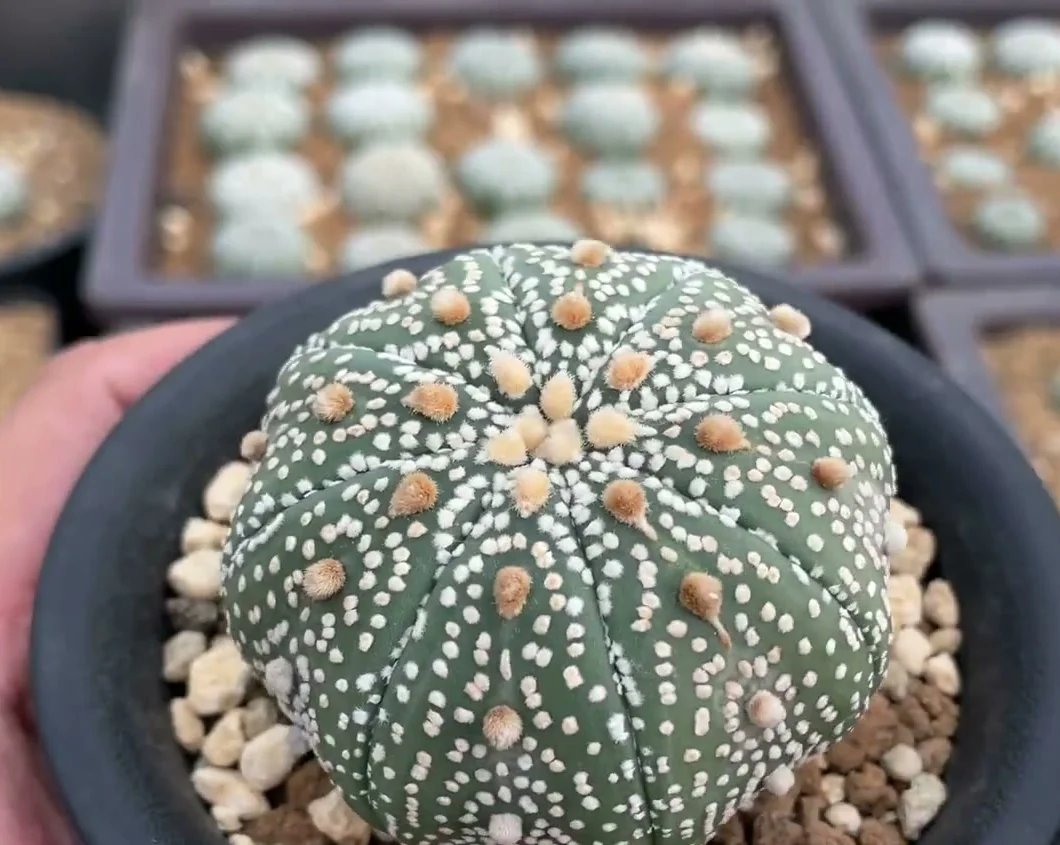
Growers here call the whole group dou (兜), the same character as the Japanese word kabuto, a helmet. I think the helmet fits better than the sand dollar on a plant this domed. The plainest form sits at one end of the range: Nudum, sold in Japanese as Ruri Kabuto, has no spots on its ribs apart from the areoles. A plant counts as Nudum as long as the spots are missing, whatever odd shape its body takes.
Sand dollar cactus flowers open from the crown
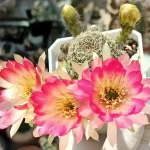
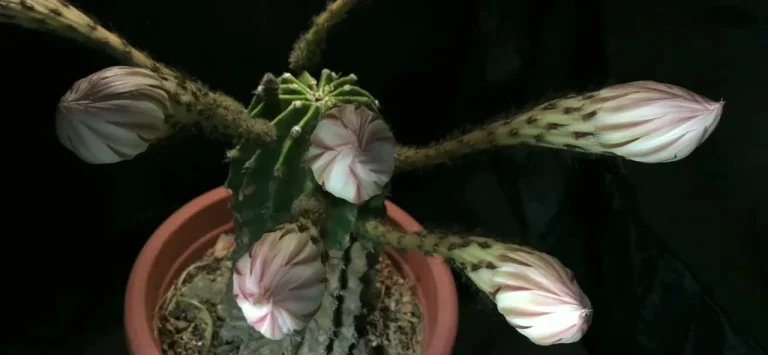
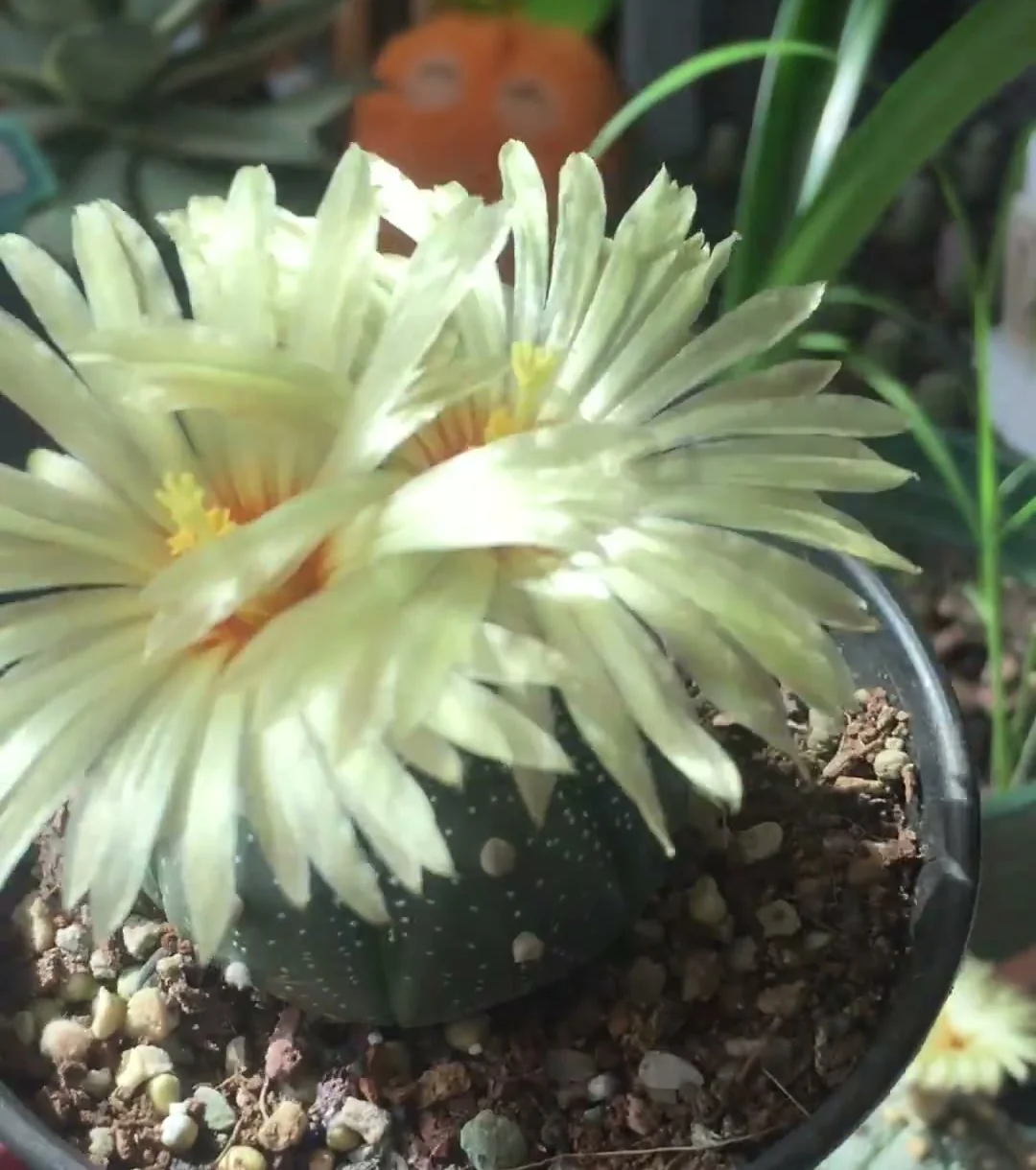
Whichever pattern a plant wears, the flowers look much the same, and they’re out of proportion to the body. Texas Parks and Wildlife describes them as yellow with a red to orange center, 1.2 to 2 in (3–5 cm) wide. In the wild they open from March through May, and occasionally after heavy rain. Buds push up from the top of the plant as fuzzy, wool-covered knobs.
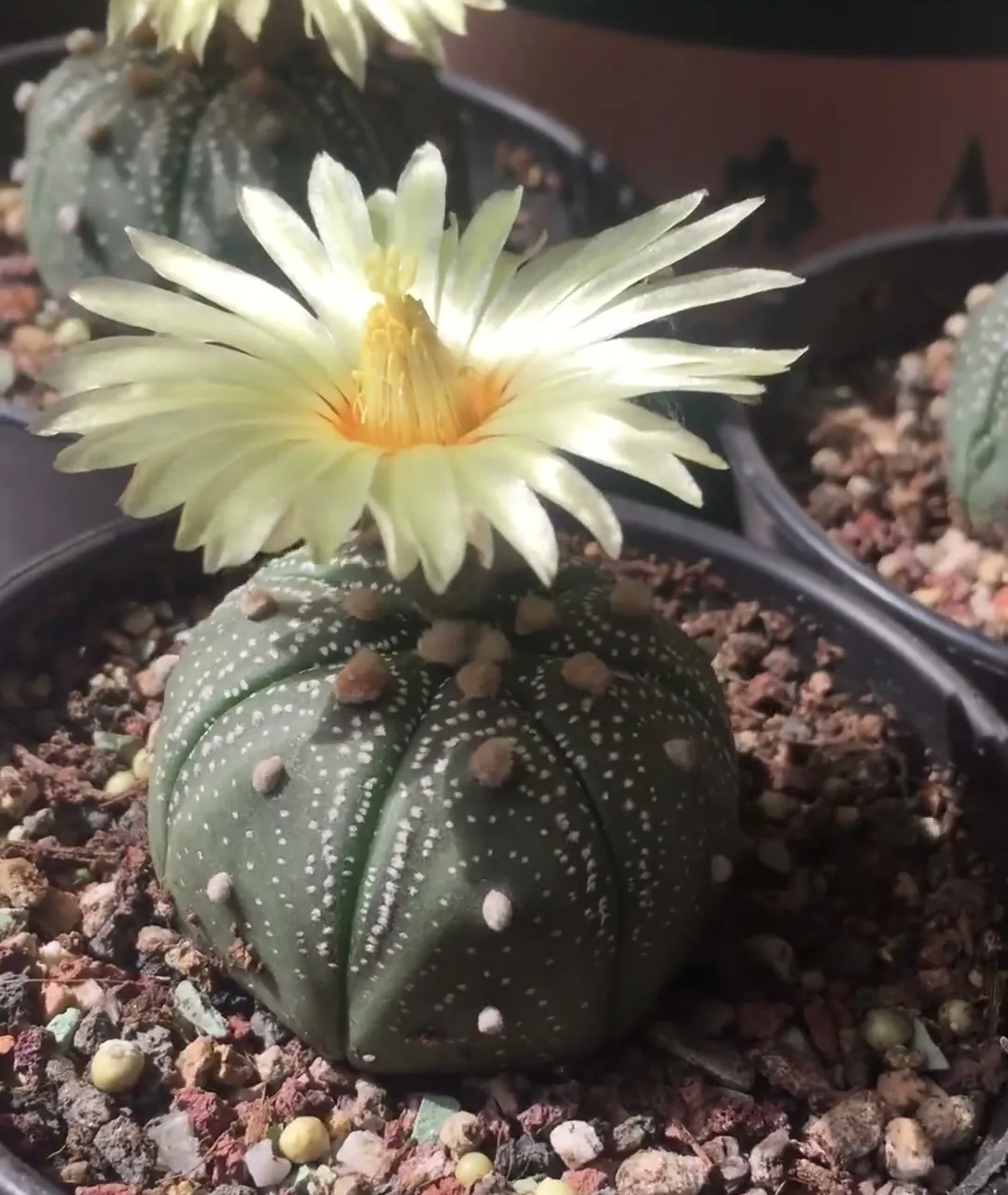
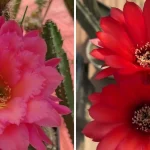
On a small potted plant, one flower can be wider than the cactus under it, and a few at once can hide the top completely. The color runs paler than the wild description in these two pots, closer to cream than to true yellow. Neither plant carried a label, so I won’t say which form they are. If yours won’t bud, the usual cause is a warm, watered winter, and I’ve written up the cool, dry rest that sets cactus buds separately.
Popular sand dollar cactus cultivars and spot patterns
Beyond the plain and lightly flecked plants, the two names you’ll meet most are Miracle Kabuto and Super Kabuto. People mix them up constantly because both are heavily marked. Treat any label as a rough guide, since most of these plants come from seed and two plants with one name can look quite different. I go by the spots themselves, then the groove between the ribs.
Miracle Kabuto: dense spots that stay separate
Miracle plants carry far more spots than the ordinary form, packed in neat lines. Look closely and each spot is still its own spot, however tightly they crowd together. The groove between the ribs stays clean, with no spots or stray fuzz in it. Under each areole there’s often a small mark like a line of eyeliner, but many Super Kabuto have that too, so it won’t settle the question alone.
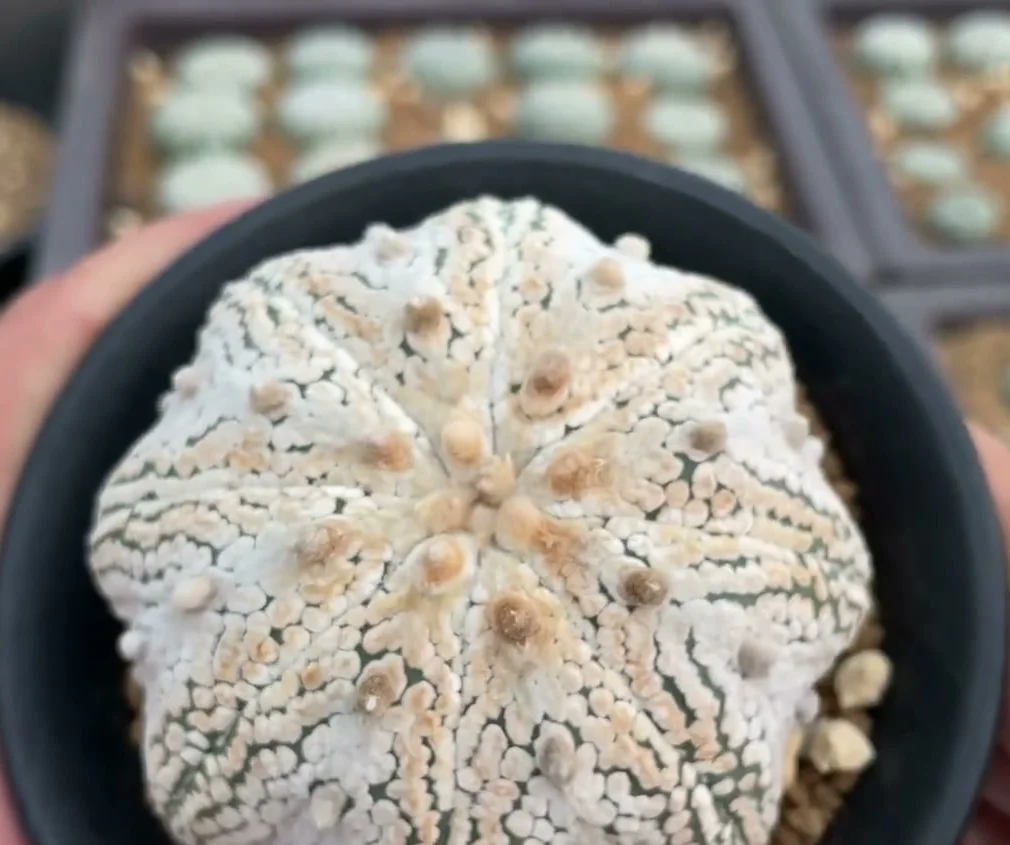
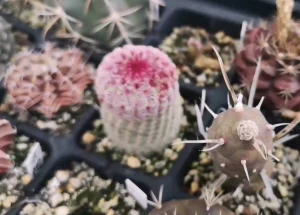
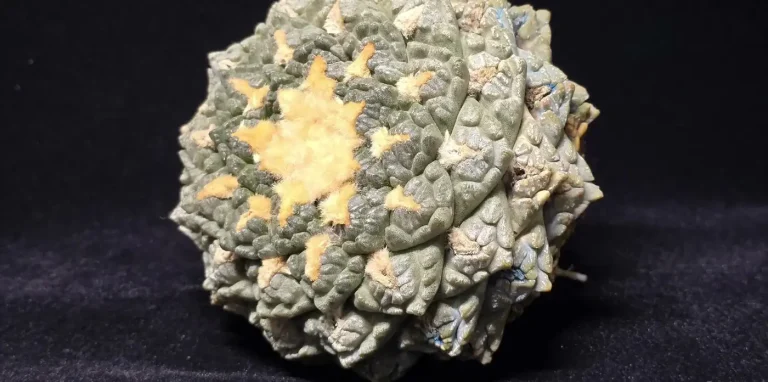
Most Miracle plants grow into a starfish outline as they age, with each rib pushing out into a point. That’s the shape I’d hold out for if I were choosing one plant for a shelf. The one below was about to flower, and you can see the fuzzy bud standing at its crown.
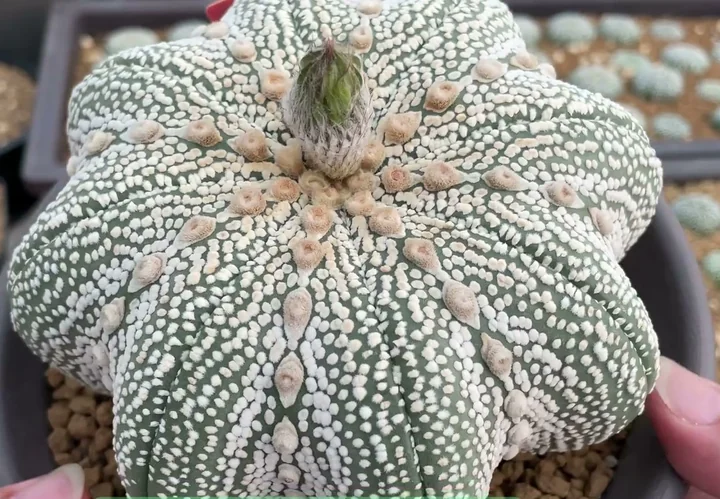
Super Kabuto: big patches that cross the rib groove
Super Kabuto spots are large and irregular, and no two match. They join up into patches and bars, so what looks like two spots often turns out to be one. Some of these patches also bridge the groove between two ribs. As the plant widens, the ribs pull apart and tear that patch, leaving a line down the groove like an open zipper. That zipper line is the one feature I treat as proof of a Super Kabuto.
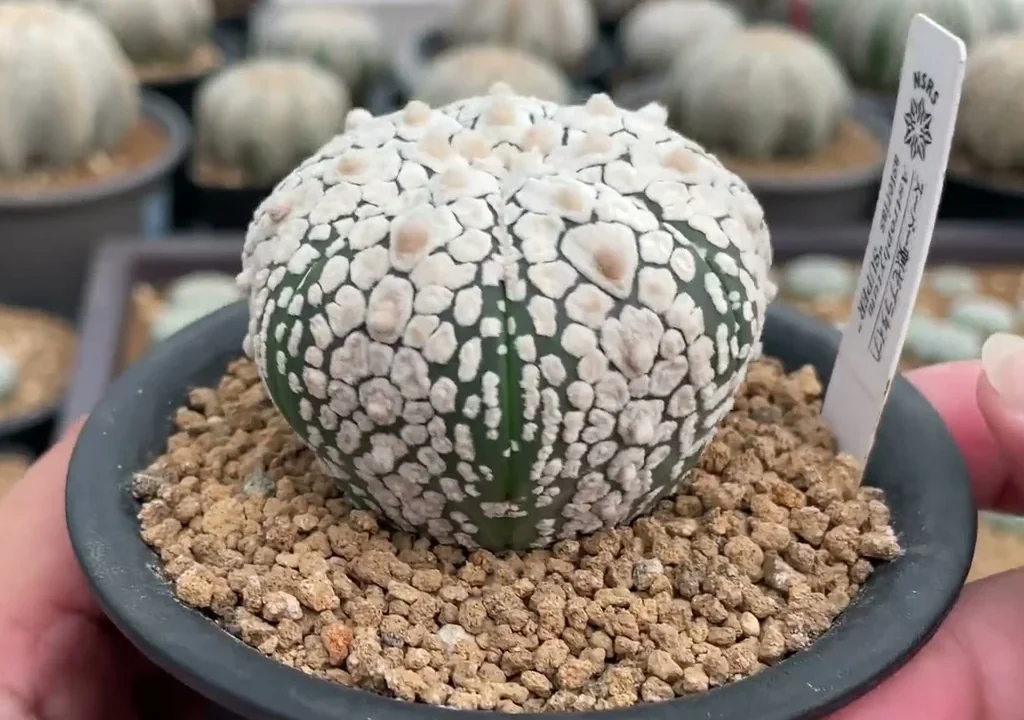
It’s also the form’s weak point. On a plant with an uneven body, the tearing shows more with age, and to my eye the plant turns scruffy. A Super Kabuto looks best when its patches stay fairly symmetrical.
| Form | Spots | Rib groove |
|---|---|---|
| Nudum (Ruri Kabuto) | None besides the areoles | Bare |
| Ordinary flecked plant | Small, loose, scattered | Not a useful clue |
| Miracle Kabuto | Dense, neat, each one separate | Clean |
| Super Kabuto | Large, irregular, joined into patches | Spots cross it and may tear |
Sand dollar cactus care follows general cactus rules
All of these forms need the same care, and a marked plant isn’t fussier than a plain one as far as I’ve seen. I don’t have a watering log or repotting record kept for this species, so what follows is general cactus practice with no schedule attached. The wild habitat gives the broad direction: gravelly soil, sparse plant cover and little shade. First cactus? The beginner basics on the home page will help before you read on.
- Light: Put it in the sunniest place you’ve got, and move a shaded plant into strong sun gradually so it doesn’t scorch.
- Soil: Use a gritty mix that drains fast. Peat-heavy soil that stays wet is the wrong direction.
- Water: Soak the pot, then let the soil dry completely before you water again. Give less as the weather cools.
- Winter: Keep it bright, cool and dry, and bring it in before frost.
- Repotting: Do it only when the plant needs it, and check the roots while it’s out. The cactus root page sorts healthy roots from bad ones.
In Huizhou, rain worries me more than sun. Summer downpours are what rot desert cacti on my roof, and a body this low sits right on the wet surface. If yours lives outdoors somewhere rainy, a clear shelter helps more than anything else on that list.
Growing sand dollar cactus from seed
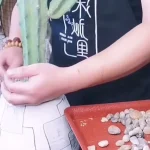
Seed is the normal way to propagate this plant, which is why nursery stock is mostly seed-grown. I sow in closed boxes, and the main difference from potting soil is particle size. I start with fine akadama, a granular Japanese clay, at about 0.04 to 0.12 in (1–3 mm). I don’t measure a ratio, because in my experience the plants adapt as long as these four parts are present:
- Akadama: the base of the mix.
- Kanuma: a mildly acidic Japanese grit that adjusts the soil’s acidity.
- Vermiculite: holds water once it’s soaked, then drains well.
- Peat: supplies some nutrition.
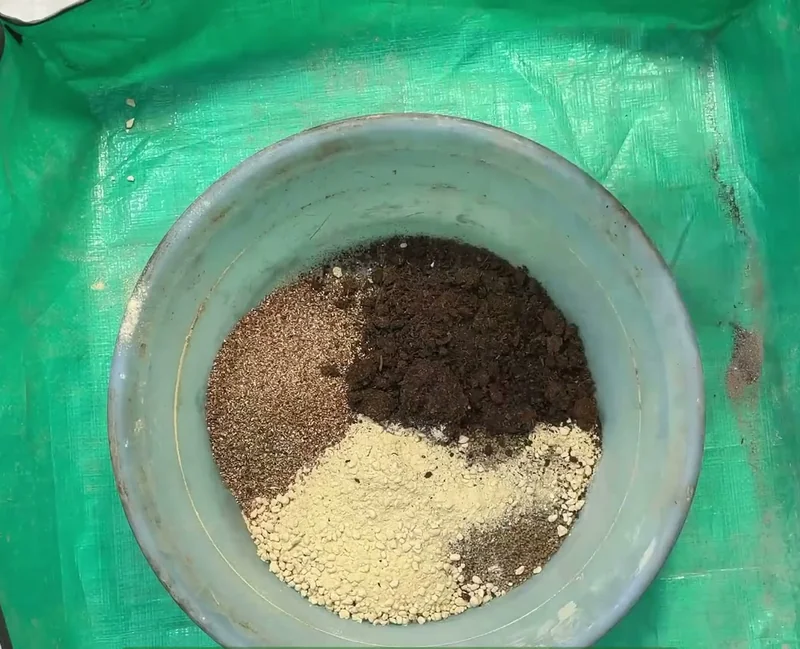
With the parts in the basin, the sowing goes in this order:
- Dampen the soil with a little water before stirring, which keeps the dust down.
- Stir it, then add a little insecticide in case the peat holds insect eggs, following the product label. Stir until even.
- Fill a deep disposable food box, leaving about 1 in (2.5 cm) of headroom. That’s my estimate of a thumb’s width. A second box turned over the top makes the closed lid, which holds in the humidity.
- Top the soil with a thin layer of vermiculite, which helps the seedlings root and stops them flopping over.
- Wet the soil until it’s moist all the way through, with no water standing in the bottom. Standing water is hard to get out of a box with no drainage.
- Set the seeds out one at a time in neat rows with tweezers.
- Mist the surface with a fungicide solution, following the product label. It guards against mold in the closed box and gives the seeds moisture.
- Label the box and close it.
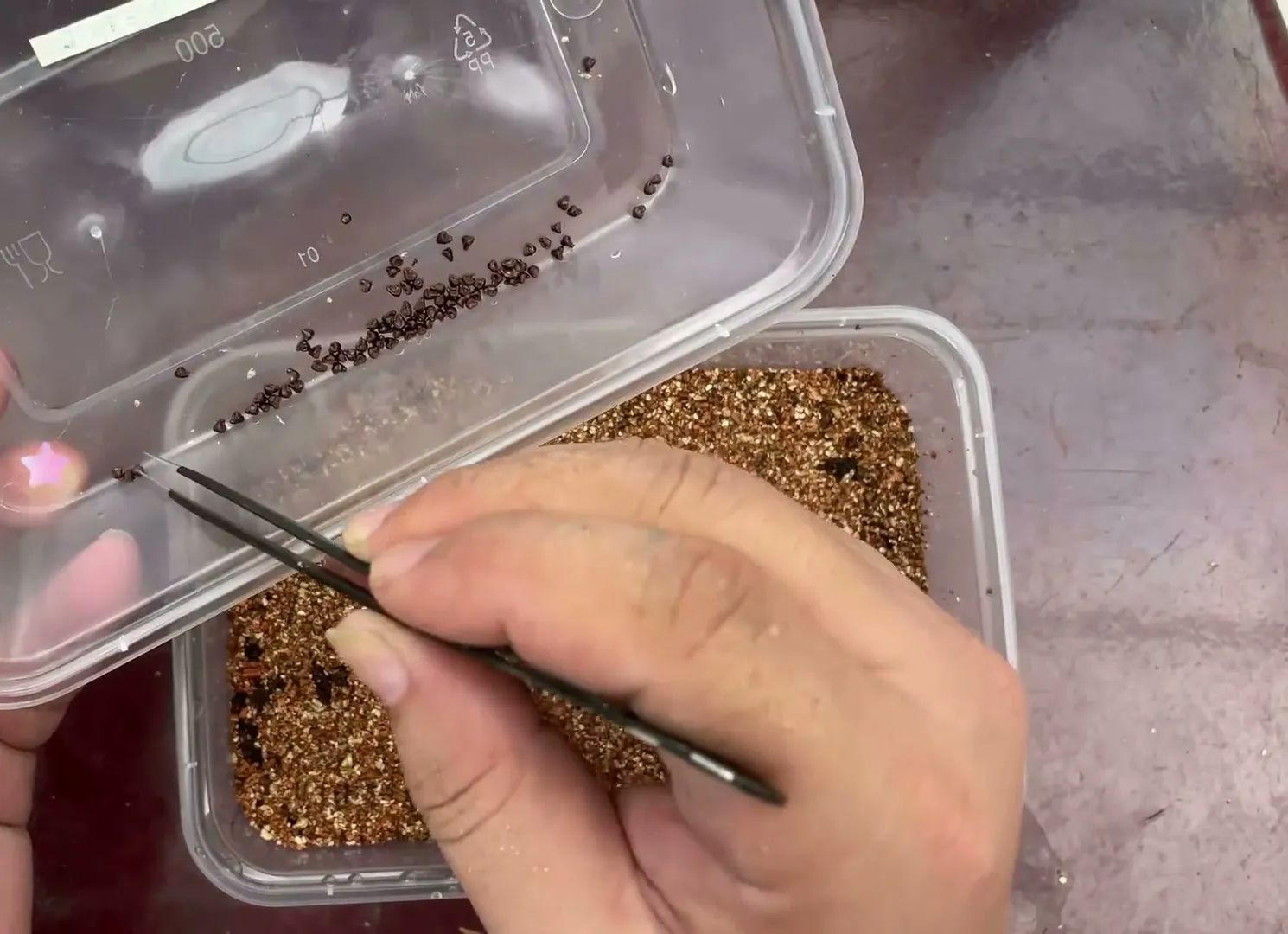
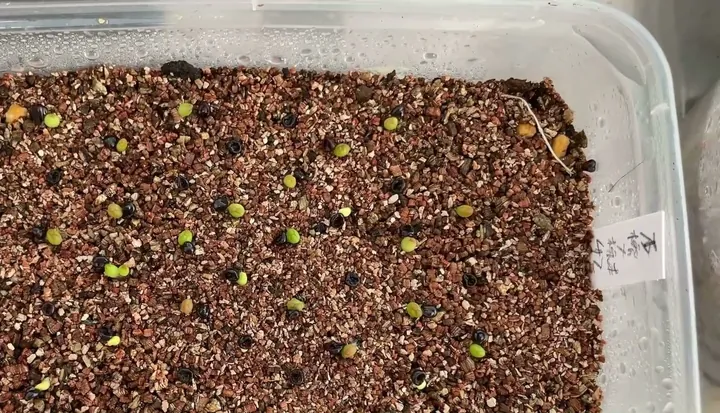
One box I sowed on September 6 had about 70% sprouted when I checked it, and I expected the rest within another week. A box sown on August 29 had nearly all come up by then. Those were late-summer sowings in southern China, so your timing may differ. My notes stop at germination, so I can’t give you a date for opening the lid or for the first repot.
Why the sand dollar cactus is endangered in the wild
All those seed-raised plants make the species look safe, and the wild picture is much worse. The U.S. Fish and Wildlife Service listed the star cactus as endangered on October 18, 1993, wherever it’s found, and Texas listed it in 1997. The IUCN Red List rates it Vulnerable, with about 5,000 mature plants at 25 locations, a falling trend and a severely fragmented population. That assessment dates from 2009 and carries a “needs updating” note.
The two ratings come from separate systems, so they don’t have to match. In its 2003 recovery plan notice, the Fish and Wildlife Service knew of only one U.S. population, on private land in Starr County, Texas. A new 5-year status review opened in March 2026, so these numbers could change. The threats that notice named were:
- Collection for the cactus trade
- Root-plowing and other brush clearing, followed by exotic grasses planted for cattle
- Oil and gas exploration
- Urban growth and road building
One more threat comes from its looks. Star peyote is one of its common names, and it’s sometimes dug by accident because it resembles peyote, a different cactus (Lophophora williamsii). International commercial trade in wild-collected plants is also barred under CITES Appendix I. I can’t give legal advice, so if you plan to sell or ship plants, ask the Fish and Wildlife Service first. The golden barrel cactus is in a similar spot, common in nurseries and endangered in the wild.
Sand dollar cactus FAQ
Is a sand dollar cactus the same as a star cactus? Yes. Sand dollar cactus and star cactus are both names for Astrophytum asterias, and you may also see sea urchin cactus. The IUCN uses sand dollar cactus, while the U.S. Fish and Wildlife Service uses star cactus.
How big does a sand dollar cactus get? A sand dollar cactus reaches about 6 in (15 cm) across and stays low, at around 1 to 2.4 in (2.5–6 cm) tall in the wild. If you want more small round plants for a windowsill, I’ve listed others in my guide to small cactus plants.
Does a sand dollar cactus have spines? No. A sand dollar cactus has no spines at all, only tufts of wool on its areoles and white flecks across its ribs, so you can handle one without gloves.
Is a sand dollar cactus rare? It’s rare in the wild and easy to find in cultivation. Texas Parks and Wildlife notes that it’s widely sold among cactus growers, and most of those plants are raised from seed, so the wild count tells you nothing about what’s on a nursery bench.